Extract from Warnings and Predictions by Viscount Rothermere
(London: Eyre and Spottiswoode, 1939)
Chapters 6 – 16, pp. 75 – 222 (end of book)
CHAPTER SIX
WHEN the various letters and articles from which I have quoted were written and
published, my gloomy prognostications about the coming change in the diplomatic
and military status of
The German declaration of rearmament in the teeth of the Treaty of
Versailles, the re-entry into the Rhinelands, the re-nationalisation
of German waterways were treated by Ministers of State and members of the
public with extraordinary complacency. Not until Signor Mussolini had shaken
all confidence in 'collective security' and Herr Hitler had attached to the
Reich both
When Herr Hitler took open power in the January of 1933, I realised that his psychology was very different from that of our own statesmen and very different from that of the men who had led the German republic.
Here was a man whose life had been hard. In boyhood and youth he had
been poor and thwarted. In early manhood he had been a serving soldier
performing the most dangerous of front-line tasks, those of a battalion runner.
He had been decorated for gallantry, had been wounded and gassed. In the years
of later manhood he, with other ex-servicemen, had seen his country thrust down
into the very mud of world disrepute. He had suffered from the ineptitude of
those charged with the Government of his country. He had been affronted by the
spectacle of members of an alien race flourishing in
This man, I knew, would
not consent to wait patiently upon the whims and ideologies of
Since he had from the beginning of his perilous political career denounced
any loyalty to the forced Treaty of Versailles, I knew that no paper bond would withhold him, and his
equally resolute and bitter comrades, from giving
At the moment of his accession
They did neither.
Could there be folly more stupendous!
By one section of the community one part of this policy was called "war-mongering," and the other part was called "pro-Nazism." Both parts were in reality a policy of Peace.
While
It was inevitable that any German regime which denounced the diktat of
I wrote in The Daily Mail of
THE PERILS OF PINHEAD PACIFISM.
"Emboldened by their illusion that this country is safe from foreign attack, ignorant and self-satisfied agitators are clamouring for the British Government to continue its dangerous policy of disarmament.
"They cling to the imbecile belief that war, which has existed since
humanity began, and looms so largely on the international horizon to-day, can
be prevented by pacifist 'gestures.' They might just as sensibly try to pacify
a
"Two kinds of people are prominent in this agitation. One is drawn from those intellectual prigs whose overweening conceit in their own wisdom and virtue is equalled only by their blindness to hard facts. The other consists of their well-meaning but sentimental and simple dupes.
"These noisy and misguided zealots start with a false assumption that
those who realise more clearly than they the danger
in which this country stands are animated by some sinister desire for another
war. They like to feel that they are crusaders against the powers of darkness.
They adopt towards the question of national defence
the attitude that is known in
"If their knowledge of history and present-day international politics
were a little less elementary, they would realise
that the opponents of premature disarmament are working for the very aim which
they themselves profess—the preservation of world-peace. The further reduction
of British forces, 'as an example to the rest of the world,' will no more
achieve this end than the disbandment of the
"Our pinhead pacifists, on the other hand, are constantly working up
that kind of spirit between the nations of
"Should such grotesque and impudent tomfoolery as the 'trial' of the Reichstag Fire case recently organised in London by the 'World Committee on German Fascism' ever be repeated when Germany has recovered her military strength, it might well be made a pretext for war by that proud and susceptible nation.
"These self-appointed mentors of
"We who live in
"The British public treats its puling pacifists with characteristic
tolerance and contempt. We know that the
"'Be strong. Strength means peace,' said Marshal Lyautey
last Monday to the French Boy Scouts at
"In contacts that I have had with masters at some of our great Public Schools and with the younger dons at the Universities, I have not infrequently been struck by the defeatist and drawing-room Bolshevist views that they express. Though these may only be part of a pose intended to convey an impression of intellectual superiority, it is regrettable that the men who are charged with the education of British youth should profess such unworthy opinions. Most of them owe their bread and butter to the wealth accumulated in the past through the expansion of the Empire they affect to despise.
"Although in this country we dislike the idea of inquiring into a man's political opinions, those who have the appointment of the instructors of the younger generation should insist that their influence shall be used to encourage ideals of good citizenship, and not the perverted and pernicious theories of a false internationalism.
"Much less tolerance can be shown to newspapers which, while making
pretentious claims to national responsibility, encourage these dangerous habits
of thought. A year or two ago the same organs were fawning upon the
anti-British agitator Gandhi. Now that this vain mountebank is discredited,
even with his own credulous followers, they are employing their mischievous
activities in baiting
"The fact recorded by the military historian Tacitus 1,800 years ago still holds good, that 'the peace of nations cannot be secured without arms.'
"Defencelessness against air attack is a direct incitement to the aggression of more energetic Powers. If the risks we are at present running were properly understood, there would be such a peremptory national demand for an adequate British Air Force as no Government could resist.
"Is it realised that our present inferiority
lays open such densely populated areas as Tyneside—that
great centre of Socialist pacifism—to the possibility of complete destruction,
with immense loss of human life, in the course of a single summer evening by aeroplanes already in the possession of
"The fastest type of German commercial aircraft is known as the Heinkel 70, and is capable of being transformed in a few
hours into a bombing machine. Quite recently one of these aeroplanes
flew from
"That is one of the plain facts which have completely altered the whole situation of this country as regards national defence. Our duty is to face these facts.
"Let us put aside sloppy sentimentalism and the vain illusion that for the first time in man's long history human nature has finally forsaken war. The day for beating the sword into the ploughshare has not yet come.
"Until it does we must pay heed to the precept implied in the motto of the Honourable Artillery Company—that fine corps of young Londoners who set so splendid an example to our neurotic pacifist youth. It reads: 'Arma paces fulcra—Arms are the basis of Peace.'"
The pinhead pacifists against whom nearly six years ago I was writing are still with us. They have learnt nothing.
For some years I was a Governor of a certain school in
"
"I note that the L.C.C. has once more refused to allow any of the schools under its control to establish a cadet corps.
"With the views that I hold it is impossible for me to be associated with a school or any other educational body which has not, as one of its primary purposes, the wish and the will to help in every possible way the cause of national defence.
"Will you, therefore, kindly record my resignation as a Governor of the St. Marylebone Grammar School?" In taking this action, I do so with much regret,
"Yours very faithfully,
"ROTHERMERE."
Not only are these Pinheads still with us, and still in control of many of our local governing bodies, but they still try to perform their second deadly function of
". . . working up that kind of spirit between
the nations of
It is not uncommon to find in the Left-wing Press references to Herr Hitler's "lunacy" and his "illusion of grandeur."
In what does this fancied lunacy and illusion of grandeur consist? In the
fact that Herr Hitler and his immediate colleagues have raised
It would certainly be the height of suicidal mania to tell such a heavy-weight that he had attained to his status by the simple process of being a certifiable lunatic with an illusion of grandeur if oneself were without any means of self-defence.
If there has been any certifiable lunacy anywhere in
One thing is quite certain—that if any portion of the pictorial and written
abuse which has been directed at the heads of the German and
The habit of jeering at and reviling these heads of other nations was
acquired when both
This misconception was at its height in 1935, when Signor Mussolini,
despairing of any results from appeals to
This campaign was a perfect demonstration of the inability of those in command of our Foreign Office and intelligence departments to grasp elementary facts and to draw from them simple conclusions. As such it deserves separate attention.
CHAPTER SEVEN
THE Italo-Ethiopian campaign was responsible for
more confusion of thought in
It gave rise to the extraordinary spectacle of Arch-bishops and Bishops rallying together to harangue masses of ignorant sentimentalists in support of the most notorious nation of brutal slave-traders in the world.
It showed a British Cabinet vainly trying to harness the non-existent—or, at least, non-responsive—forces of the League of Nations in defence of a nation against whose admission to that very League Britain had herself protested on the score that it was a barbaric conglomeration of tribes whose nominal head was in no position to fulfil his obligations.
It showed, indeed, many another anomaly of which history will take satirical account.
At the outset of the episode there were clearly two separate considerations
involved. One was where justice might lie in the prolonged dispute that had
come to the arbitrament of arms. The other was
whether
Both of these were widely discussed at that time. With the first I shall deal, briefly, a little later in these pages. The second now seems such a palpable absurdity that it is hard to recapture the angry moods of 1935, when the public believed with great military "experts" and statesmen that the best for which Signor Mussolini might hope was a long, dragging, four-year campaign, and that the most likely result would be that the Italian legions would be "bogged" in Ethiopian swamps, drowned by the much threatened rains, and finally massacred by the "righteous" hordes of the Negus.
My own conviction and prediction, published through The Daily Mail, was
that
The actual campaign in
Even as late as the September a
New Statesman pamphlet on
"The duration of the war is reckoned by Italian military experts at two years: by most foreign experts at at least four years, followed by guerrilla fighting for an indefinite period."
A very celebrated General who had been out with the Italian army as an observer submitted to me, in the middle of the campaign, a lengthy memorandum conclusively proving that Italy was doomed to defeat by Abyssinian conditions, and later demonstrated to me and a number of guests round my table that in such a country the aeroplane and the tank must be ineffective instruments.
The reasoning behind my conviction that
There was also a moral factor, and, on the much-quoted adage of Napoleon, in
war the moral to the physical is as three is to one.
Many of those who regarded my forecast of a short campaign as unsound were
undoubtedly affected by their belief, or hope, that
For some reason the British public in 1935 were allowed to believe that
after the Walwal incident, Signor Mussolini moved
troops to Abyssinia and began an aggressive war, in the face of any obligation
Italy might have under the Covenant of the League, which is, as is well known,
the first part of the Treaty of Versailles, which Italy as a victor had signed.
The calendar of events tells a very different story. The Walwal
incident took place on
It was, in view of these things, quite a rational assumption by
For
Pinhead pacifists had screamed for more and more reductions in arms. Their screamings had been listened to with full attention. The
only means of taking measures against
In addition to these material factors was the moral factor that
To ignore these things was not patriotic or brave, but merely foolish. To recognise them was not unpatriotic or defeatist, but the necessary result of honestly facing facts and their implication. If there were any lack of patriotism it was in those who, knowing the truth, endeavoured to direct Britain into a policy which the truth stamped as fatuous at best and fatal at worst.
The world had already had one or two pitiable exhibitions of how impotent
was the truncated
There was no reason whatsover [sic] for supposing that, having failed
in these tests, the League would miraculously be able to apply pressure to
On the grounds that I have just set out as briefly as possible, I concluded
that any attempt to impose Sanctions on
Because of these convictions, the papers whose policies I directed were from the first strongly against the whole policy of Sanctions. They applauded the present Premier, Mr. Chamberlain, when he called that policy the very midsummer of madness. They preached from the very start of the conflict that truth which Mr. Eden himself eventually had to formulate towards the end of the sorry episode—that there are only two kinds of Sanctions, the ineffective economic sanctions that are not worth putting on, and the military sanctions which must mean war.
Every prediction I made, every warning I uttered about Sanctions proved one
hundred per cent. right.
"But yesterday the word of Caesar might have stood against the world: now . . . none so poor to do him reverence." That was the only fitting inscription for the doors of the British Foreign Office after the policy of Sanctions had been launched and had failed.
I say again that British policy at the time of the Abyssinian campaign was politically a blunder of the worst possible kind, and was morally a mistake which is already having the most devastating effects upon the future of the race.
Our unworthy association with Communist Russia and what—under politicians
like M. Blum—looked like a half-Communist France on behalf of the barbaric
slave-traders of Ethiopia set us in opposition to the very nation from which
the whole culture of Christendom was derived. Italy, the cradle of the arts and
the home of the Church when both arts and the Church were most imperilled, was affronted and antagonised,
while the Godless murderers of Moscow and the torturing tribesmen of Abyssinia
were exalted as our chosen friends. Why? Because
It was incredible to me then, and it is appalling to me now, that for such unworthy objects we should have sacrificed the good-will of such a friend.
Sacrifice that friend we did. The British representatives at
The poor little betrayed Negus was not to be the last of the victims of the
sentimentalists' demand that
It looks as if General Chiang Kai-shek before long will join Dr. Schuschnigg and Dr. Benes as the dupe of a sentimental but impotent British foreign policy.
It is strange how many of our most vocal sentimentalists feed themselves upon illusion, which must have proved in the last few years a most unsatisfactory diet.
The same people who predicted that Italy would be ruined by her campaign in
Abyssinia, and prophesied that the independence of Austria would be maintained,
and said that the forces of Czecho-Slovakia would
intimidate and over-awe Germany, are now nursing the strange illusion that the
war in China is gradually destroying and absorbing the forces of Japan.
Actually,
The fiasco of Sanctions, against which, both before and during their imposition, I perpetually warned my fellow-countrymen, had the dire effects I predicted. The possibility of such a blunder in foreign policy lay in the very weakness to the exposure of which I have devoted the earlier chapters of this book—the weakness of under-rating the Totalitarian States. The strength and determination of Signor Mussolini were under-rated, just as the strength and determination of Herr Hitler had been—and are—persistently under-rated.
Even after
The failure of the British statesmen and their expert advisers rightly to
assess the weight and power of
The basis of all policy, as of all strategy, must be information. Had the British Cabinet between 1933 and 1938 been supplied with accurate information and wise advice by those serving them abroad it would have been impossible for such colossal misjudgments to be made.
Too often are wrong appointments made in
Occasionally, it cannot be doubted, a man who insists upon sending home news and views which do not support the predilictions of his 'Chief' is translated to some other post in some other land, to make room for a more somnolent or sycophantic representative.
I have called the Abyssinian campaign a perfect demonstration of the inability of those in command of our Foreign Office and intelligence services to grasp elementary facts and draw from them simple conclusions. It was a perfect demonstration, but by no means an isolated one. Our attitude towards the Sudeten German problem in Czecho-Slovakia was such another.
IN 1927 I launched a campaign to secure for
In 1927 I wrote:
"
"Of the three treaties which rearranged the map of
"As they now run, the frontiers of the new Central European States are
arbitrary and uneconomic. But they have a more serious aspect still. Their
injustice is a standing danger to the peace of
"The hands that imposed the political conditions now existing there sowed the seeds of future war. . . . We ought to root up all the dry grass and dead timber of the Treaty of Trianon before some chance spark sets fire to it. Once the conflagration has started it will be too late."
("
So impressed was I by my investigations into the political situation during
my visit to
This was the article:
GROSS INJUSTICES MAKING FOR WAR
"
"It was the professed aim of the Peace Conference, when it gathered in
"In the Peace Treaty made with
"For similar reasons the world's interest in peace-making evaporated,
and the light of publicity which had been concentrated on the work of the
Conference was withdrawn. In reality only half the work of restoring a lasting
peace to
"This negligent procedure suited very well the intrigues of various minor nationalities which had come to be associated with the Allied cause, and which stood to profit considerably from the settlements thus obscurely made.
"Representatives of these new-fangled nationalities immediately began
to arrive in large numbers in
"These abuses were committed in the name of self-determination. If that
principle had been strictly observed all round, there
would have been no cause for complaint. But the creation of Czecho-Slovakia
was an artificial operation only carried through by out-raging the principle of
nationality which it was supposed to serve. There never had been a state or
nation of Czecho-Slovakia, although in the Middle
Ages there had existed a
"The Union of the Czechs with the Slovaks had been brought about only as the result of a meeting held at Pittsburg, U.S.A., during the war, at which the Slovaks, upon a pledge of autonomous home-rule for their people in any future Czecho-Slovak State that might be formed, agreed to support the demands of the Czechs when a Peace Conference should assemble. The conditions of this pledge, like those of the subsequent Treaty of Trianon, have not been carried out by the present Czecho-Slovak Government, with the result that bitter recriminations are now being exchanged between the two chief racial sections of the new republic.
"To find territory for this
"No sooner had the Czechs got control of the Hungarian population ceded
to them than they began to subject it to oppression by the side of which the Germanisation of Alsace-Lorraine pales into insignificance.
The Czecho-Slovak Government adopted towards its
Hungarian minority population a deliberate policy of expropriation of property,
which has continued unchecked up to the present time. The compensation for the
seized property was so insignificant that it was virtually confiscated. No
financial accounts of this expropriation have ever been published, nor have
repeated appeals to the Czech Government resulted in their production. If only
half the stories that are told about these land deals are true, the Czech
Government is responsible for tolerating some of the worst frauds that have
ever taken place in the public life of
"No heed was paid to the expostulations of the twelve Members of
Protest whom this Hungarian minority (despite the dragooning of the electorate
by the Government) returns to the Czech Parliament, nor did the injustice done
attract any attention elsewhere in
"Such conduct is specially odious in the case of Czecho-Slovakia,
for this State is a spoilt child of fortune. Apart from a handful of Czech
'legionaries' who came over to the Allies, the Czechs fought on the side of the
Austrians to the last. It was thus a curious freak of fortune which enabled Czecho-Slovakia at the end of the campaign to assume the
role of a triumphant conqueror while imposing upon
"Czecho-Slovakia owes her independence, in
fact, solely to the philanthropy of
"The position of this post-war republic is by no means secure. In
domestic affairs the mixed elements of which it is compounded—Czechs, Slovaks,
Hungarians, Germans, Moravians, Poles and Ruthenes—are
so antagonistic to each other that the disappearance of the State by sudden
disintegration from within is always a possibility. In this way she constitutes
the powder-magazine of
"One thing is certain—Czecho-Slovakia cannot continue her present exploitation of her subject populations, whether they be Hungarian, Austro-German or one of the other nationalities. By doing so, she will affront the public opinion of the world, and this is a risk no modern state dare incur.
"The Czecho-Slovak Government must soon take a momentous decision. Will it elect to stand upon evasion and perversion of the Treaty of Trianon, or will it follow counsels of reason and justice by saying to Hungary: 'We do not wish to retain within our frontiers compact blocks of Hungarian population against their will, and we agree to a revision by plebiscite of our frontiers in this respect'?
"If such a rectification could be brought about, I should recommend that Hungary should reimburse Czecho-Slovakia for any money spent since the Treaty of Trianon upon the retroceded territory, and for the loss of employment on the part of Czecho-Slovak public functionaries, but there must be a set off in the shape of adequate compensation to the Hungarian nationals who have been wrongfully dispossessed of their properties.
"The idea of an independent Czecho-Slovakia first reached the minds of the masses of the Western nations through The Daily Mail and its associated newspapers, and I very much doubt whether, except for the publicity thus given, Czecho-Slovakia, as we know it to-day, would have had any existence.
"M. Masaryk, the President of Czecho-Slovakia, was during the war a highly esteemed member of the staff of contributors to these papers. I am convinced that President Masaryk himself is not satisfied with the present position in regard to the Hungarian minorities in his country, for it is stated in this month's Fortnightly Review that in a recent treatise entitled The New Europe he envisages a revision of the present frontiers of Czecho-Slovakia. I cannot do better than quote his exact words. He wrote:
"'The settlement of ethnographic boundaries after the storm of war will possibly be provisional in some cases. As soon as the nations quieten down and accept the principle of self-determination, a rectification of ethnographic boundaries and minorities will be carried out without excitement and with due consideration of all questions involved.'
"I was one of those who welcomed the erection of Czecho-Slovakia into an independent State, and I should be sorry to see that country forfeit the confidence which the Allied nations placed in it. I realise, as every thinking man must, the standing danger to European peace of allowing Czecho-Slovakia to remain an exposed political powder-magazine. Two years ago I decided to draw attention to the perils of the present position, but I then determined to wait until the Treaty of Trianon had been in operation seven full years, so that whatever adjustments were essential could take place in the calm atmosphere of mature reflection.
"I have some hope that the Czecho-Slovaks
will see how plainly to their own interest is the course that I recommend. In a
large measure their development depends upon foreign financial help. Any
international banker will tell them how gravely the risks of their present
internal and external position compromise their standing in the money markets
of the world. As one who claims some knowledge as an
investor, I cannot imagine any securities with less attraction for the
well-informed investing public to-day than the State Loans of Czecho-Slovakia and
"What I claim for
"This state of things is an outrage to an ancient and splendid people
with a history of high endeavour extending over a
thousand years. It is fundamentally wrong, and it cannot endure. There is time
now to right it peaceably and effectively. If we continue to close our eyes to
the evil it will keep alive the spirit of hatred and hostility in
"Are we so blind as to let the elements of another terrible conflict
accumulate unchecked? It is the duty of
That article was written eleven years before Herr Hitler's march into
"No observant man can travel through
"All natural principles of frontier delimitation were rejected. The new
boundaries had no justification, whether ethnographic, geographic or economic.
They set up in
" . . . Serious possibilities of future trouble for Central Europe
exist also in that other Peace Treaty of St. Germain
by which the territory of Austria was carved up, principally for the benefit of
Czecho-Slovakia, in such a way that the great city of
Vienna, with two million people, was left practically without national
territory to supply its needs or consume its products. . . . The Austrians in
despair have come to look to union with
There were, even then, two sides to the question. There was the repugnance
with which great people like the Hungarians saw a million of their fellows under
the tyranny of the Czechs and the Austrians saw their ancient capital brought
to virtual ruin, and there was also the dislike of a proud people like the
Germans for the domination over their national destinies of the conglomerate of
small nationalities at Geneva. Of this second aspect I was vividly aware long
before Herr Hitler had taken power in
"A powerful, highly patriotic people like the German will never be satisfied to leave the attainment of their national ambitions at its (the League of Nation's) mercy.
"It is more likely that when a National Socialist Government arrives in
power,
"In doing so she will achieve something far greater than the 'anschluss'—or union with
"As a result of such developments, Czecho-Slovakia, which has so systematically violated the Peace Treaty, both by its oppression of racial minorities and its failures to reduce its own armaments, might be elbowed out of existence overnight."
I wish, particularly, to emphasise that this
article from which I have just quoted was written in 1930. It foretold both the
rise of the National Socialist Party to power in
The more I studied the Central European situation, the more convinced did I become of these things.
Nearly six years after the publication of that article, in May 1936, a close
and trusted colleague of mine returning from
"If it is not
Within a year the anschluss
was an accomplished fact; within less than eighteen months Czecho-Slovakia
had been made to render back to the Germans the
The Czech tyranny was indeed strangled.
It was between 1930 and 1936 well within the competence of the British
Government, acting through
Nothing was done.
During those years, particularly in the latter three,
In April 1936 this was so obvious to me that I wrote, in an article called
"
"New forces are rising in Europe which will make short work of the opposition of those over-indulged and mischievous countries Czecho-Slovakia and Rumania, which, after unjustly despoiling Hungary, have black-mailed the Great Powers into allowing them to keep their plunder. . . . The Czechs, indeed, had no separate existence till after the war, and the vast majority of them continued to fight for the Central Powers right up to the Armistice. A small contingent of deserters and political exiles joined the Allied armies under the name of the Czech Legionaries. They were diligently publicised by certain British pundits who specialised in Central European affairs. . . .
Just how those pundits caused the creation of Czecho-Slovakia
I set out at length about a year later when, on
THE PRISONERS OF CZECHO-SLOVAKIA
"Most blunders in life
have to be paid for. The blunder of creating that synthetic and spurious State
called Czecho-Slovakia may well cost
"Of all the reckless things done by the 'peace-makers' in
"The Czech and pro-Czech intriguers who bamboozled the peace delegates
had an easy game. Those overworked and weary statesmen were under strong
pressure to finish quickly their recasting of the map of
"A small set of self-seeking or time-serving 'experts' flooded them with one-sided memoranda, minutes, digests, drafts, summaries and maps. The result was that they imposed a settlement entirely in the interests of the Czechs.
"'The agreements and bargains were made behind closed doors,' says the American delegate, Mr. Lansing, in his history of the Peace Conference. One British journalist who was prominent in the hole-and-corner dealings to which Czecho-Slovakia owes her baneful and fraudulent existence boasted in a speech that 'a few experts knowing their own minds and concentrating all their efforts on a given end, can sometimes achieve ends unattainable by the leaders of uninformed opinion and uninformed statesmanship.'
"These Czechs were one of the subject races of the Austro-Hungarian Empire
before and throughout the war. Owing to the fact that the Czech soldiers
deserted in unusually large numbers, it was possible for pro-Czech busybodies
in
"At the Peace Conference this view was pressed upon the Supreme Council
with much bogus evidence to back it up. A typical example was the notorious
'Pittsburg Agreement' of
"When the document was presented to the Peace Conference it occurred to
no one to point out that the Czechs and Slovaks who had accepted were all
American citizens, and as such hardly qualified to decide the fate of
"But Czechs and Slovaks combined numbered only 8 1/2 millions. Accordingly, by all sorts of specious arguments of which the peace delegates in their haste would admit no rebuttal, the Czech leaders asserted a further claim to annex large blocks of peoples of entirely different race.
"In this way Czecho-Slovakia was rounded out on the North by the inclusion of 3 1/4 million Germans who had hitherto been under Austrian rule, and in the south by the ruthless appropriation of three-quarters of a million of pure-blooded Hungarians.
"These two solid contingents of foreigners have since been held as prisoners of Czecho-Slovakia. They were handed over to the Czechs with no more consultation than if they had been cattle, and have been treated by the Czech authorities with no more regard for their rights and feelings.
"As captives of a race notorious for petty meanness they have been subjected to cold-blooded expropriation and oppression. Every effort has been made to suppress their languages, and the Czech police have tried to break their spirit by systematic persecution.
"Last year a Defence of the Realm Act was passed which exposes any German or Hungarian to instant deportation from his home on the frontiers to the interior of the country at the whim of the local Czech authorities.
"For, loaded as they are with spoils, the Czechs have a guilty
conscience. They have armed intensely without regard for the spirit of the
Treaty of
"Had it not been for Hitler, the Czechs might never have had to rue
their evil doings. But the immense development of armed strength in Nazi
Germany now threatens them with retribution. The grievances of the 3 1/4
million Germans who live under the oppressive rule of
"The dragon's teeth that the Czechs have sown are sprouting all around them in a crop of deadly dangers.
"Dreading this menace of retribution, Czecho-Slovakia
last year made a pact of mutual assistance with
"The only effect of this has been to fan the smouldering
wrath of Germany, for Czecho-Slovakia, thanks to the
position carved out for her in the heart of Europe, might well serve as an
advanced base for a Soviet attack on Germany. From aerodromes on Czech soil the
Bolshevist bombers could be over
"Ten years ago I said in these columns that Czecho-Slovakia
was a disturbing element in
"There might still be time for the Czech Government to make reparation, but it is under the control of the same scheming politicians as brought that hybrid country into existence.
"Dr. Benes, the chief begetter of the
"Dr. Benes had done well out of his political career. Signs of the wrath to come suggest he would do well either to retire or to reform his prison-camp policy. It is significant that his country has not a single friend among the five States on her own borders.
"The Pharaoh who hardened his heart was engulfed by the
Despite the onward roll of events which I tried to depict in that article, British rearmament lagged tardily behind even our barest need, and no attempt was made to achieve redress of Central European grievances by diplomatic means.
By April 1938 all that I had predicted of danger had come to actuality.
In that month I had reached my seventieth birthday, which I celebrated by landing from a trans-Atlantic journey just before making a tour of certain European States where, as is my custom, I desired to see things for myself and obtain information at first hand. I could not, I felt, relinquish the political and executive control of The Daily Mail—which I had determined to do at that age—and remain utterly silent upon what I knew to be the gravest set of dangers that had ever threatened the British people. I therefore arranged to contribute some six or seven articles to that paper which took the form of a kind of causerie on current affairs.
My apprehension about the danger to world peace of the situation in Czecho-Slovakia was so acute by this time that this topic in those notes was dominant. Why this was so will be apparent from my remarks published on April 29th, under the heading "A Few Postscripts."
"Numbers of our pugnacious pacifists are now saying that we should stand up for Czecho-Slovakia. Do they realise that almost half its population regards the Government of Czecho-Slovakia as a tyranny?
"Do they realise that the country contains 3,500,000 Germans—24 per cent. of its population—who are deadly hostile to that Government, and with reason?
"In addition to this German minority there are great minorities of
Hungarians, Poles, Slovaks and Ruthenians who detest
the tyranny of
"There are at this moment in Czecho-Slovakia 1,300 citizens awaiting trial on charges of military treason, a significant symptom of terror and unrest.
"This caricature of a country under its Czech leaders has from the moment of its birth committed almost every conceivable folly.
"Contrary to the spirit of the very Treaty which created its Constitution, it has armed to the teeth, and used its arms to dragoon those minorities which were handed over to its untender mercies without the asking of their yea or nay.
"It is not the Germans alone who were treated with brutality. Quite recently members of the Hungarian minority found themselves denied visas to enable them to cross the Czecho-Slovakian frontier to their original native country even when their purpose was so personal and so sacred as to attend a mother's funeral.
"The 3,500,000 Germans in Czecho-Slovakia, be it remembered, form a larger community than the
population of
I added that in my view the British Government should
warn
A week later in the second of my "Postscript" articles, I repeated:
"Czecho-Slovakia is not of the remotest concern to us.
"If
I added to a somewhat lengthy consideration of the state which the problem had then reached a repetition of my warning that:
"Nothing should induce the British Government to mix itself actively in this dangerous problem.
"The Germans are a very patient people. I cannot imagine for one moment
that
My concern with the Central European problem, as I have said earlier, was
twofold. The injustice to such a noble people as the Hungarians evoked general resentment. As with
"Reiteration is the
soul of journalism"—so I hammered again at my urgent warnings on
"We should keep," I wrote, "an entirely free hand in Central
European questions. Just as we would refuse to join in any plan for the
encirclement of
"To divert purchases from other parts of our own Empire in favour of produce from South-eastern
"Our interests do not lie in
"We should look after our Dominions and overseas possessions and proclaim it as our policy that whatever happens on the Continent of Europe—except, possibly, a menace to the French and Belgian frontiers—is no concern of ours.
"If
"
"Some ten years ago I received a 'round robin' signed by twenty high officers of the active and reserve army of Hungary, asking me to go to their country and take a hand in its government.
"I told them I thought Admiral Horthy was a great Hungarian patriot who was admirably fulfilling his duties as Regent of Hungary.
"As for a restoration of the Monarchy, I said that they could not go outside the old royal line, and if there were to be any restoration at all, a Hapsburg must succeed a Hapsburg.
"For nineteen years the Government at
"With the aid of her good friends
"There is no more stirring incident in the whole history of
"The appeal of the Empress to the people and nobles was made in 1741 at
the old town of
"It is almost incredible that this historic town should have been ceded
to Czecho-Slovakia, but so it was. Immediately the
Czechs obtained possession they had the effrontery to change the name to
"Could wanton insult and outrage be carried further?
"Ten or eleven years ago a British officer who had served on the Central Commission on Territorial Questions at the Peace Conference said that the Commissioners were responsible for the inclusion of Pressburg in Czecho-Slovakia.
"I said it was a damned shame.
"His excuse was that the Commission had been told to hurry, that haste was supremely important. The Commission, in fact, had no time for proper examination and consideration.
"It was thus that one of the gravest injustices in history was perpetrated.
"If peace is to have a chance, the sooner the Czecho-Slovakian
problem is settled the better. It is at present a canker in the heart of
Fortunately the whole of the British people were not seized by that queer madness which elevated Dr. Benes to the status of a suffering and persecuted Saint and the Czecho-Slovakian majority into the role of martyrs. The truth did begin to prevail.
In dispelling the fog of falsehood which surrounded the Czecho-Slovakian problem, Mr. Lloyd George did his share. In The Truth About the Peace Treaties (Volume II) he gave a very frank picture of the means whereby Dr. Benes had bamboozled—there is no other word—the Allied Powers into creating Czecho-Slovakia. I cannot do more than extract a few passages:
"On February 5th the Peace Conference," writes Mr. Lloyd George,
"invited Dr. Benes, the Prime Minister of the
new
From this Pecksniffian attitude Dr. Benes advanced to definite proposals and pledges. He said he:
". . . wished to observe that the Czecho-Slovak Government had no intention whatever of oppressing (the German Bohemians). It was intended to grant them full minority rights, and it was fully realised that it would be political folly not to do so."
This protestation, so soon to be broken, he followed with a Memorandum which
he addressed to the New States Committee of the Peace Conference (
"It is the intention of the Czecho-Slovak Government to create the organisation of the State by accepting as a basis of natural rights the principles applied in the Constitution of the Swiss Republic, that is, to make the Czecho-Slovak Republic a sort of Switzerland, taking into consideration, of course, the special conditions in Bohemia."
Mr. Lloyd George follows the text of this Memorandum by the setting out of
seven specific pledges given by Dr. Benes, each one
of which was afterwards broken or disregarded (Truth About the Peace Treaties, Vol. II, page 937). He
promised "an extremely Liberal regime, which will very much resemble that
of
The changing view of the English that Czecho-Slovakia was not a worthy occasion for war enabled me to write more hopefully on May 20th:
"I find a growing appreciation of the justice of
I foresaw that any relief of the Sudetens which
was not accompanied by a similar relief of some, if not all, of the other
minorities, would bring not peace but a sword to
"Christendom as a whole owes
"For more than two centuries
"The endurance which the Hungarians showed in those days towards the Turkish invaders they have displayed since the last war.
"Notwithstanding the impositions, humiliations and cruelties which were heaped upon them by Czecho-Slovakia, they have refrained from violence, and have patiently endured their sufferings in the full hope and knowledge that redress would not be denied to them.
"The Germans, with whom they fought side by side, regarded them as the worthiest of their allies in the last war. The British who fought against them, found them among their stoutest foemen."
Eventually, by the efforts of
The full fruits of that demonstration
CHAPTER NINE
THE end of the iniquitous treaties which had made the Czech tyrannies
possible came, as all know, in October 1938. Instead of coming, as it might
have done, by amicable arrangement, it came by a threat of war. Mr. Neville
Chamberlain, Prime Minister of Great Britain and the leading statesman of the
British Empire, had thrice to fly hurriedly to Germany, and had to invoke the
aid of Signor Mussolini, whom Britain had treated so contemptuously three years
before, in an eleventh hour attempt to prevent the defenceless
millions of Britain from being exposed to the danger, if not the actuality of
German bombs. By so doing he saved the peace of
It may be easy now for some minds to minimise the danger of September 1938. At the time it was real enough.
My warnings had always been that no more terrible mistake could be made than to suppose that Herr Hitler was a bluffer. When he insisted upon justice for the Sudeten Germans he was prepared to back his insistence by strong arms. He was ready, if necessary, to face a world war. This he told Mr. Chamberlain frankly.
That the international wrong of placing Hungarians under the heels of the
Czechs would some day bring
The treatment which
Between the visit of Mr. Chamberlain to Berchtesgarten
and his visit to
The British know now, through the revelations of such men as General Harington and Captain Liddell Hart, that
neither in these islands nor in the
I had predicted the danger long before it developed and had repeatedly warned the nation, as this book records, of its complete unpreparedness. Because of this I watched with special sympathy and anxiety the great efforts which Mr. Chamberlain was making to avert a catastrophe.
Central Europe in arms and mobilised—and the German
Fuehrer about to address his own nation in a speech which might mean the
launching of war—that was the situation at the very height of the crisis, on
"You have had proofs of my friendship towards
"Peace and war are in the balance, and like you I know what are the horrors of war, for, as you are aware, I lost two of my three sons in the last war.
"A hopeful word from you would bring relief to millions."
"Yours very sincerely,
"ROTHERMERE."
War was averted, thanks to the initiative and energy of Mr. Chamberlain and
the co-operation of Signor Mussolini. The
The later restoration of Hungarian territories and populations, of which I
have written in the previous chapters, was the inevitable sequel. The agreement
of
What the democratic States, with their often reiterated adulation of "self-determination" had failed to do for the oppressed minorities under Dr. Benes, the Totalitarian States had done. They had done it because they were ready to fight if necessary for a justice about which the unarmed nations could only talk.
In that tremendous week Herr Hitler had the fate of
CHAPTER
It is foolish to sneer at truisms. They are valuable because they are truisms—in other words, they are true. One of the most hackneyed of them is that it is impossible to make omelettes without breaking eggs. Another is that you cannot make a revolution in kid gloves.
The happy and sheltered peoples of the British Isles, who have known neither
invasion nor revolution for centuries past, resent bitterly and strongly the
methods of force which were used by both Signor Mussolini and Herr Hitler in
establishing and maintaining their respective systems of government. Both
Fascism in
The necessity for such use of force was well understood by Lord Baldwin, who has never shown himself friendly to either Fascism or Nazism, when he told the House of Commons that:
"The German is naturally a law-abiding man, and he had a glimpse into
the abyss when Communism in
For the understanding of Herr Hitler and his remarkable career
it is necessary that the circumstances of his attainment to leadership should
first be understood. For the bath of misery in which the Germans were compelled
to wallow during the years when waves of inflation rolled over their economic
heads the victors in the last war were largely to blame. They did not give to
the old
Herr Hitler was one of those gallant men of the trenches who returned to
civilian life to find their ardours and sufferings
and bravery scoffed at by those they had tried to defend. Eventually he saw his
race, both in
The means and weapons by which Nazism in
While I have always understood the British antipathy to the use of physical
violence, I have equally understood the causes of its use in countries abroad
of different circumstances from our own. I understand it there, just as I
understand the causes of the violence shown to the rebels in
For this reason, and because I knew the man, I felt constrained, when Herr Hitler was being roundly abused by the English Left-wing Press, to tell the British public what I knew of him. In two issues of The Daily Mail in May 1938 I wrote of him what I now gladly put on more permanent record:
"Great numbers of people in
"He is supremely intelligent. There are only two others I have known to whom I could apply this remark—Lord Northcliffe and Mr. Lloyd George. If you ask Herr Hitler a question, he makes an instant reply full of information and eminent good sense. There is no man living whose promise given in regard to something of real moment I would sooner take.
"He believes that
"Herr Hitler has a great liking for the English people. He regards the English and the Germans as being of one race. This liking he cherishes notwithstanding, as he says, that he has been sorely tried by malicious personal comments and cartoons in the English Press.
"I was talking with Herr Hitler some eighteen months
ago when he said, 'Certain English circles in
To this I added some details of a conversation I had had with him about relative air strengths, and the following week, in response, as will be seen, to the interest my picture of the man had aroused, I wrote further:
"My remarks about Herr Hitler last week aroused a great deal of interest, apparently, among readers who hitherto have had to form their idea of him from newspaper comments and caricature.
"Herr Hitler is proud to call himself a man of the people, but, notwithstanding, the impression that has remained with me after every meeting with him is that of a great gentleman. He places a guest at his ease immediately. When you have been with him for five minutes, you feel that you have known him for a long time.
"His courtesy is beyond words, and men and women alike are captivated by his ready and disarming smile.
"He is a man of rare culture. His knowledge of music, painting and architecture is profound."
Many people seemed to find difficulty in reconciling the conception of a man of culture with a man of resolute action.
Why this should be so, I do not know. British 'Christian Generals' like
It is probable that if a poll were taken to decide who in common estimation is the greatest political Englishman ever thrown up in our history, the name of Cromwell would lead all others. But Cromwell was a man of the greatest determination and the most ruthless methods.
The two sides of character shown by such honoured Englishmen and by Herr Hitler are as familiar as anything in human history. Shakespeare was aware of them when he wrote:
"In peace, there's nothing so becomes a man
As modest stillness, and humility;
But when the blast of war blows in our ears,
Then imitate the action of the tiger;
Stiffen the sinews, summon up the blood,
Disguise fair nature with hard favoured rage. . .
."
Whatever means the new regime in
"Herr Hitler's policy is achievement without bloodshed. He reached
supremacy in
"In the troubles in
It was because of current misunderstanding about
"My special study of
"Herr Hitler has several times mentioned my campaign for a large air
force for
"Without adequate arms a nation suffers from a want of self-respect. An
unarmed country is a poor compliment to all those who built it up by endeavour, initiative and sacrifice." {f/n 1: These
quotations are from the articles "Further Postscripts" and "Some
More Postscripts" in The Daily Mail of May 13th and
My belief in the necessity for amity between London and Berlin was proved to
be sound when less than half a year afterwards Mr. Chamberlain had to use his
efforts with Herr Hitler at Berchtesgarten, Godesberg and Munich to keep the peace, and managed to
bring back from his third journey the 'half-sheet-of-notepaper' pledge of the
two countries not to resort to war in future, but to settle their differences
by amicable conferences. Certainly the policy of insult and exasperation
pursued by some of
The folly, apart from the danger, of such a policy was displayed more than thirty years ago in the brilliant maiden speech of my old friend Lord Birkenhead, when, as Mr. F. E. Smith, he launched a characteristically witty and biting attack on Mr. Lloyd George for his propaganda methods in favour of Free Trade.
"The President of the Board of Trade," said 'F.E.,' "informed
one audience how large a part horse-flesh plays in the
simple diet of the German people. The same speaker is never tired of
maintaining that protection has tainted and corrupted German public life. I
understand that any trade negotiations which may become necessary with
What was folly in 1906 was worse than folly in 1938.
Were I to make public some of the communications which I have had from Herr Hitler, in a correspondence bridging now several years, it would be apparent that one of his dearest hopes, cherished, as he himself has told me, long before his advent to power in Germany, is that Germany and Britain should stand side by side in amity.
One sentence I may quote, for it is in no way different from some of his
public utterances. It is this: "Whatever may happen, I want to assure you
at the conclusion of this letter that I firmly believe that a time will come in
which
On another occasion Herr Hitler said to me, "If to-day I stand for an
Anglo-German understanding, this does not date from yesterday or the day
before. During the last fifteen years I have spoken in
Despite the necessity for subordinating nearly everything to the gigantic task of rearming his country, Herr Hitler has a reasoned, as well as a temperamental, aversion from war. Some six years ago he expressed to me the belief that a methodical, scientific examination of European history over the last three hundred years would show that nine-tenths of the blood-sacrifices of the battle-fields was shed entirely in vain—that is to say, in vain measured by the natural interests of the participating nations.
He made no exception in the case of
As I have said earlier, people have accused Herr Hitler of megalomania.
That, of course, is always the charge levelled
against a man who emerges from the ruck and takes and
wields power. It was said of Caesar, it was said of Napoleon, it was said of
That Hitler has a great and even mystic faith in his destiny is true. It would be strange, in the light of his achievements, if he had not.
He is quite aware of the view of him that is held. In an interchange of views about the possibility of Anglo-German friendship that I had with him not very long after his coming to power, he wrote:
"I have derived from fate the heavy task of giving back again to a
great people and State by every means its natural honour. I see in this one of the most essential
preparations for a real and lasting understanding, and I beg you, Lord Rothermere, never to regard my work from any other point of
view. The feelings and views of Parliamentary demagogues are liable to rapid
and unexpected changes. The world may, however, for what I care,
reproach me with what it will. One reproach they certainly cannot level at me:
that I have been vacillating in my views and unreliable in my work. If an
unknown man with such weaknesses set out to win over a nation in fifteen years
he would meet with no success. Herein resides, perhaps, the faith—exaggerated,
as many believe—in my own personality. I believe, my dear Lord Rothermere, that in the end my unchanging standpoint, undeviating
staunchness and my unalterable determination to render a historically great
contribution to the restoration of a good and enduring understanding between
both great Germanic peoples will be crowned with success. And believe me that
this is the most decisive contribution to the pacification of the world. An
Anglo-German understanding would form in
In Signor Mussolini's phrase, much water had flowed under the bridges of the Tiber, the Spree and the Thames since those words were written, but I, for one, have no doubt that they still express the international idea of the German Leader.
I know that when the Anglo-German Trade Agreement was reached, Herr Hitler's belief was that it might well pave the way to a wider and better understanding.
In one of his addresses to his own people, Herr Hitler declared that his true wish was to see Germany freed from the necessity of wrangling with her neighbours, that he might pursue his work of rebuilding the nation not only metaphorically but actually.
His plans for the replanning of the great German cities are very dear to his heart. It can never be for-gotten, when one enjoys his personal hospitality, that in the days of his extreme youth, and extreme poverty, his aspirations were purely artistic and architectural. Those aspirations were thwarted by circumstances, but the inner spirit which inspired them has not really changed.
He has in him something of the dual nature of our own General Wolfe, the
conqueror of Canada, who, as all schoolboys know, said he would rather have
written Grey's 'Elegy' than take Quebec. If ever, by the grace of God,
This is a side of his character which is rarely shown to the British public by those who comment upon him. It is, probably, a side completely overlooked by our diplomats in their dealings with him.
In writing thus of Hitler, the man, I have no desire merely to 'glorify' him or to seem to condone some of the acts and measures which he has found necessary during the six years of his autocracy to bring his people from the slough of odium and distress to their old position as a great nation able to bargain on terms of equality with their neighbours. My only desire is to give a sound perspective to the portrait of him in British minds, and to show that the ogre is, as I wrote a year ago, a human being of great culture.
That the starveling youth of
In talks with the ex-Crown Prince of
He expressed himself to me as a great admirer of the Fuehrer, whose rise to power, he said, was no temporary thing.
He added that in a few months Herr Hitler had established a stable
Government which had done wonderful things for
What the ex-Crown Prince said only confirmed the views I had formed myself over several years of acquaintance with the German people.
Whatever there may be in store for the old dynastic families of
Signor Mussolini, whose friendship I also enjoy, is a man of different mould. He has not the same mystic intensity which characterises Herr Hitler. He, too, is a man of the people, but he is also a man of the family.
Their careers have been oddly similar. Both were born in humble surroundings. Both fought gallantly in the Great War. Both led movements against a wave of Communism and attained supreme command at an early age.
But the nature of the task was different. It may almost be said that whereas
Herr Hitler had to recall his people to a former glory under a once-familiar
mode of life, Signor Mussolini had to create in his countrymen a new nature. It
is obvious to anyone who has frequently visited
Between the clean, tidy, self-respecting city of
For centuries
In his work of creating the vigorous, self-respecting nation that we know
to-day he expected at least the approbation of
The destiny which both Herr Hitler and Signor Mussolini know themselves to
be fulfilling is that of defenders of
When, in 1917, the extreme Left-wing took power in
It would have been thought that amity between the British, who were the prime object of attack from Bolshevist-Communism, and the two nations which had successfully defeated attacks from that source would be a natural and simple attainment. So both Herr Hitler and Signor Mussolini at one time thought.
For some reason difficult to fathom, the blood-bath of Moscow, the tyrannies
and the cruelties, impinged with less horror upon the English mind than did the
castor oil of Rome or the concentration camps of Berlin. The cousin of the
English King and his family were brutally murdered, hundreds of thousands of
men and women were shot down, a reign of Godlessness was declared in
It is strange that although something like 2,000,000 White Russians wandered over the earth seeking a refuge from terrorism and the persecution of Red Russia, there was not, as far as I remember, a single one of our Bishops or great public men who raised a voice in their behalf.
There was no Albert Hall demonstration. For them there was no Mansion House Fund.
In fact, it looked like an agreed silence in regard to what was, unquestionably, the greatest persecution of innocent human beings in the past five hundred years.
The necessary repressive measures in
One reason, without doubt, for this difference of attitude was that from
1933 onwards Herr Hitler had roused an emotion—or, to be more accurate, two
conflicting emotions—long dormant in the more civilised
portions of
I have never been identified with anti-Semitism. Many of my personal friends have been of the Jewish race, and I have a deep appreciation of all that our modern civilisation owes to the work of Jews through the ages.
Having said these things, I may, without being misunderstood, say this—the
people of
While this does not excuse the methods by which the Semite problem has been
tackled by
We have within recent years seen the renewal of diplomatic relations between
However repellent the British mind may find the German and Italian methods of dealing with a severe internal problem, those methods are less revolting than those used by the regime of Lenin and Stalin to deal with their internal troubles, which we have cheerfully condoned.
They may seem horrible to sheltered minds in snug British townships, but it behoves us to remember that our treatment of the Arabs in
What Sir Henry Campbell-Bannerman called our 'methods of barbarism' in
Whatever the recent drift apart of
"Miracles are done by faith.
"The Germans have found a new and potent faith.
"It has wrought the miracle of removing the mountains of difficulty that barred their way to national recovery.
"But it has accomplished even more. It has given
"The last two years have witnessed here a political process as profound and far-reaching in its effects as the French Revolution.
"Such a change in the character of a nation, in its internal conditions, its international standing, even in the very bearing of its people, has never before in history been achieved within so short a time.
"I warn my fellow-countrymen that
"
"Anyone who visits
"After less than two years of his administration the following results stand to Hitler's credit:
"1. German unemployed on the day he took office numbered 6,014,000. On November 30th this year they were 2,354,000.
"2. National and municipal Budgets have been restored from ruin to solvency. The Finance Minister recently stated that revenue had increased by more than £80,000,000, showing an improvement in the national position amounting to £200,000,000 a year in all.
"3. For the past two months
"4. The Germans are fast making themselves independent of foreign raw materials. They can now produce artificial rubber at no more than twice the present low price of the natural commodity. Hundreds of research chemists are working at the development of artificial cotton and wool. They are hotfoot on a clue which may lead to the discovery of a completely satisfactory substitute for tin at one-tenth of its cost.
"5. Two hundred and fifty
thousand young men are in Voluntary Labour Camps,
benefiting from the finest imaginable physical and social displicine.[sic] These are adding largely to the real-estate
values of
"6. One thousand four hundred miles of the finest motor roads in the world are nearing completion, giving well paid employment to 95,000 men directly and 110,000 indirectly; 4,000 miles of such roads are planned.
"7. Such a spirit of
national solidarity has been created that during the past two months an immense
sum in cash has been collected to help the poor this winter, while gifts in
kind to an equal value have been contributed. The Sunday I spent in
"Every fair-minded
person who knew
"Are we in
"As I have said before I now repeat, that nearly all the news regarding the Nazi regime published even in our most responsible journals is pure moonshine. These have spread, for instance, the impression that German Jews lead an almost hunted existence. Yet in German hotels and restaurants I have frequently seen merry and festive parties of German Jews who showed no symptoms of insecurity or suffering.
"I was glad to read the statement made in a wireless broadcast by Sir
Austen Chamberlain since I have been in
"I regard Germany to-day as not only potentially but actually the strongest Power on the Continent of Europe, for what she may lack in material equipment—and this, I believe, amounts to very little indeed—is more than made up by the superb spirit of the nation and its supreme confidence in its Leader.
"We have no ground of quarrel with these people. Their interests, our own, and those of the entire civilised world will be best served by close and friendly co-operation between us.
"When once a few of the more glaring injustices imposed by the Peace
Settlement have been removed, there will be no reason why
"We and the Germans are blood-kindred and, as Herr Hitler remarked to me, our nations have fought each other only once—though in many campaigns they have been faithful allies. The German Chancellor repeatedly expressed in our conversations his desire for a complete Anglo-German understanding, which he regards as a sure road to peace.
"If
"There will never be a better opportunity than now, when all the forces and energies of that splendid nation are held in one strong grasp.
"Could we but bring about this better feeling between the two countries in 1935, the coming year would be one of the most fortunate in the memory of mankind."
(Daily Mail, December 28th 1934.)
CHAPTER ELEVEN
NOBODY can hope to understand Herr Hitler or the
The Germans have always felt that they were tricked into the Armistice. They could have fought on, causing the loss of many hundreds of thousands of lives. They did not fight on, to the last gasp, because they were offered an armistice on specific terms laid down by President Wilson and assented to by the Allies. Those terms included the promise that German territories would not be taken from them.
In addition to the Fourteen Points of President Wilson's famous 'Note' and the Four Points of what is known as his 'Four Point Speech'—on which the Armistice was accepted—the Germans had been told by all the resources of modern propaganda that the Allies were not fighting for territorial aggrandisement and were not fighting the German people, but only the Kaiser and the Junkers.
They rid themselves of the Kaiser and his Junkers, and they accepted the Armistice.
On the very morning that the Armistice was concluded, the British Premier,
Mr. Lloyd George, said at the Guildhall in
"We do not seek a yard of real German soil."
Two days later at
"What are the conditions of peace? They must lead to a settlement which
will be fundamentally just. No settlement that contravenes the principles of
eternal justice will be a permanent one. The peace of 1871 imposed by
I cannot claim, any more than lair. Lloyd George, to know exactly what are the principles of eternal justice, but I do know that
they cannot be reconciled with broken pledges. Not only were many yards of
German soil taken from
If the Peace of 1871 outraged all principles of justice and fair play, it
did not rend from
This taking of
In advocating an Anglo-German Pact I was never under any illusion that the
way to such a desirable end would be smooth. From the viewpoint of
But I felt, with Herr Hitler, that only by such a friend-ship could world
peace and the security of the White race be secured. I also felt, to my alarm
and regret, that most of my fellow-countrymen were not really aware of what was
happening in
I again warned those who read my Press articles that we were drifting towards a disastrous conflict with the new Rome–Berlin axis, a conflict that need not occur.
In uttering that warning in May 1937 I was careful to take full notice of the difficulty which might arise over the question of the ex-German colonies.
At that time, as even now, many honest but ignorant electors in
On
I WANT AN ANGLO-GERMAN
"Big things are happening on the Continent, and
"Those deliberate and undeviating dictators, Hitler and Mussolini, are
dividing
"The Duce's recent interview with the Austrian Chancellor in
"For the past three years
"
"What resistance to the activities of such a union can be offered by a
still unarmed
"At present we are drifting steadily towards a disastrous conflict with
this new German–Italian alliance. There is but one way to avert it, and that is
for the British Government to take the initiative in making a pact with
"In both countries the desirability of such an agreement is admitted. Herr Hitler has several times declared to me his readiness to meet us half-way. A large and influential body of British public opinion favours closer Anglo-German relations. The difficulties in the path are not of principle but of detail.
"The most conspicuous of them concerns the former German colonies now administered by the British and Dominion Governments under mandate.
"With regard to these territories there is much misconception among
British people. The mandated lands are not in any sense British property. They
are not our colonies. They are merely placed under British and Dominion
administration by a series of mandates from the
"Even so, German South-West Africa would have to be excluded from the
bargain, for it has been practically annexed to the Union of South Africa and
is not at our disposal. But
"These countries are rich in colonies. It would cost them little to
combine in making some fresh and satisfactory allotment to Germany of African
territory, not necessarily corresponding to the earlier boundaries. By this
step they would remove the main obstacle to better and more secure relations
between the Powers of Western Europe. They would also confer a boon on
"The Germans feel their total deprivation of colonies as a humiliation.
It inspires them with a resentment out of all
proportion to the intrinsic value of the confiscated territories. We have the
power to remove that grievance, and it would be short-sighted folly to keep the
peace of
"The financial loss entailed by a reasonable restoration of African
territory to
"The suggestion that the restoration of German rule in
"By obstinately holding on to former German colonies which have not become British colonies and have comparatively small value for us, but which Germans believe would be very valuable to them, we are keeping alive in Germany a sense of wrong which will assuredly one day develop into active hostility. For the removal of such a risk a transfer of a few hundred thousand square miles of African territory would be a small price to pay."
It will be seen that my prediction as to where the fate of Czecho-Slovakia would ultimately rest was amply fulfilled.
It is now obvious that my warnings about
Perhaps the most important warning of that early article is that the return
of some of the confiscated territories, or the granting of lands in lieu of
them, is for
Naturally,
Many Englishmen, I know, with sincere, but as I think mistaken patriotism,
resent any suggestion that a consideration of the German colonial question is
even practical politics. They say with satisfying assurance that Herr Hitler
will never risk a world war for the sake of a few thousand miles of indifferent
colonial land. This they say even though they are themselves prepared to risk a
world war for the retention of those lands. But in saying so they miss the whole
point of the German colonial question. It is not the few thousand miles of
indifferent colonial lands that are in question; it is
The points involved are simple and few. They are these:
(1) Was the taking of
(2) If so, is
(3) If not, does Britain prefer to embark upon such a destructive war rather than consent to an equitable re-distribution of colonial territories which would transform a bitter and antagonistic Germany into a friendly power heartily co-operating in the work of preserving world peace?
Those, surely, are the root principles. They can be, and are, complicated by other and admittedly difficult aspects of the question.
We are told, for example, that native populations must not be bartered from one controlling white nation to another like pawns on a chess-board. They were so bartered after the last war, to our supposed benefit.
Actually, the Mandate system was devised as a form of trusteeship to prevent any victor nation from fully incorporating native races into anybody's colonial Empire.
We hear much, also, of the strategical aspect of
the question. It is urged that
But all these considerations fade to nothing in my mind before the main consideration—that of keeping Britain out of a new war, which at worst would mean the end of us and all for which we have stood, and at best would leave us shattered and impoverished to bewail the loss of hundreds of thousands of British lives.
That this must be
WHY NOT A
"Mussolini is now visiting Hitler, and their meetings may lead to the
discussion of a Four-Power Pact between
"For the moment the first steps appear to have been taken in an attempt
to link up the
"No country has greater interest in the preservation of world peace
than
"Five years ago
"It is five years this month since
"Now that
"Mussolini was the only European statesman who recognised the possibilities which that moment presented. He publicly declared that Germany's claim for equality of armaments was just, and to enable it to be met he proposed that the four Western Powers should enter into a ten-years pact of peace, for, as he rightly argued, 'the composition of the League is too general for effective action.'
"This was the origin of the 'Four-Power Pact,' which was the nearest approach to a European settlement since the Treaty of Locarno.
"Hitler, who had just taken over the Government of Germany, agreed to
co-operate. Mr. Ramsay Mac-Donald, then Prime Minister, went to
"The equality of rights and revision of the Peace Treaty then denied to
"Before the risks of the present position in
"By the subsequent inclusion of
"The only alternative to closer understanding is ultimate war. The alliances that now separate the nations of the Continent into compartments are like cracks in a chalk cliff, which steadily deepen until a landslide results.
"There are at present seven major groupings creating lines of international cleavage. They are:
"1. The 'Rome–Berlin axis';
"2. The Franco–Russian alliance;
"3. The Franco–Czecho-Slovak alliance;
"4. The Russo–Czecho-Slovak alliance;
"5. The Little Entente;
"6. The Balkan League;
"7. The
"Each is a potential source of friction. It can only be a question of
time before this frictionisation of
(Daily Mail, September 28th 1937.)
Throughout any discussion about the return of the ex-German colonies I have
always held that
CHAPTER TWELVE
IF the warnings and predictions which I have reprinted, or to which I have referred, in this book were summed up they would amount to this:
The triumph of Herr Hitler in Germany in 1933 meant the doom of the Treaties
of Versailles and Trianon unless Britain and France,
with the aid of a still friendly Italy, were prepared vigorously to rearm in
their defence; the failure of Britain and France to realise this in time meant that the doctrine of 'Collective
Security,' which really meant reliance upon an uneasy association of unarmed
Powers through Geneva, was a political futility; the wanton antagonising
of Italy in 1935 meant in its turn a strengthening of the forces opposed to
Versailles and all its works. Such a strengthening of those forces meant that
To this many people may say, as people have said, "Are we then to
desert our ally, France? And are we to condone the aggressiveness of
During my six years' campaign for a sane foreign policy I have not shirked the necessity for dealing with these aspects.
It always seemed to me that if the admittedly punitive Treaty of Versailles was to be enforced, it must be enforced at every moment and turn of events with vigour. It was illogical to suppose that the Allies could frame a tyrannous Treaty and then hope to maintain it by methods of softness.
That was why I applauded the French realism in 1922.
But just as
If, as a man of business, I had a partner who contracted some habit of laziness, or worse, I should not be blamed for striving to sever my affairs from his in order to join them to a more reliable and dynamic associate.
My concern for France in 1933—which I have marked as the key year of modern history—was second only to my concern for Britain. This the French generously realised, as this note from one of my Postscript articles amply shows:
"In their attitude to me foreign Governments have been very generous. When I, in collaboration with that great old Frenchman, the late Senator Menier, Chairman of the Air Committee of the French Senate, had for some time diligently advocated in French newspapers the building of 10,000 aeroplanes for France, the French Government wished to confer on me what was for an unofficial foreigner a most unusual distinction—the Grand Cross of the Legion of Honour."
(Daily Mail, May 6th 1938.)
Actually, my campaign for
I then said:
"I am convinced that no country is more earnest than
"
"She has the most powerful army in the world—but not even that will ensure peace.
"
"In 1914 it was nineteen days after the declaration of war before the first enemy soldier set foot upon French soil. In any future war enemy 'planes could be over French territory in as many minutes.
"In the last war there were two distinct regions—le front and l'arrière. In aerial war there will be only le front—and it will extend to the farthest borders of the country.
"If I were a Frenchman I should not feel secure until my country possessed absolutely overwhelming superiority in the air.
"The power of destruction and the range of action of the aeroplane have undergone prodigious expansion since the war. Cities like Paris and Lyons now lie within an hour's flight of the frontier for the heaviest bombers.
"The latest German passenger-machines, such as the four-engined D2,000 type, have a
carrying capacity of three tons. That means that ten such aeroplanes
could drop on
"Reducing their load to two tons apiece, they could fly 1,000 miles out
and home. The transports bringing troops from the French territories in
"The pacifist Socialists of Marseilles, which is only 350 miles from
the nearest point of the German frontier, would be as directly exposed to
bombardment in any future war as the citizens of
"These are dangers against which the most formidable fortifications in the world give no more protection than a row of railings. Heavy guns, huge fleets of tanks, a whole nation in arms—all of these are powerless to ward off the all-pervading destruction that can come, swiftly and often unseen, by way of the air.
"Weapons and traditions handed down from the last campaign will prove a handicap rather than an advantage to the country that retains them. International conflicts of the future will be unlike those of the past by as much as the Great War differed from the combats of cave men.
"No nation that is not unchallengeably strong in aerial armaments can feel secure. Knowing that France is one of the mainstays of European peace, I should like to see her splendid aviation corps raised to the strength of 20,000 war-'planes, including both the fastest fighting and the heaviest bombing types.
"This could be done without any heavier burden of expenditure, for the possession of so powerful an Air Force would be in itself an almost complete guarantee of the integrity of French soil. The cost of national defence in both man-power and money can be greatly reduced by the large-scale use of aeroplanes. For frontier patrol work the aeroplane puts all other arms completely out of date.
"The keen foresight of the French General Staff has already assured to
This forecast of military events and relations had a striking confirmation nearly eighteen months later.
In the Revue Hebdomadaire of April 1935 appeared a remarkable article signed XXX. The anonymous author was understood to be a high General on the active list of the French army. There were suggestions that the work had been inspired by General Gamelin, the Chief of the General Staff.
So strongly did the warning of XXX appeal to me that I had
translations of the article made and circulated to the leading British
Ministers and certain high officials. This article immediately on publication
was unquestionably communicated by the military attaches in
I fully appreciated the purpose behind this article and its value, just as I
recently appreciated the efforts of Captain Liddell Hart to arouse
The article by XXX had world publicity. It was an event. But even
while I stress its importance, I share fully the belief that when it was
written
The article is far too long for me to reproduce here, but one or two passages from it will demonstrate how timely had been my own words to the French in 1933.
Here are some of the conclusions reached by this French General:
"
"The mortal danger is from the air. Aircraft will play the leading rôle in the drama, and the first act will be staged on the
frontier. . . . Here is how I visualise the
inevitable drama. On the very first night our Air Force, which is criminally
concentrated in a dozen bases, will be wiped out, together with its sheds, its aeroplanes and its aerodromes. At the same time our
covering forces between
"The air menace comes before everything else. It comes first on account of the initiative that it gives to preparation as well as its execution. . . . All those who have not studied and meditated the integral problem in its dominant aspect—the primacy of the air—have forfeited all claims to govern or to command.
"Just as our military force must be prepared for instant use, so must we have an Air Force immediately ready to stop or to counterbalance an enemy air force."
This article, if anything, erred on the side of pessimism.
It was used as a means of speaking over the heads of the politicians to the French people, and it was thus couched in more sombre terms, perhaps, than was fully justified. It was intended to ring through the country like a clarion call. In many ears it sounded so.
With such warnings being uttered, backed by a command of technical detail,
Part of the truth about the lack of energy in both
The Locarno Pact, upon which great hopes were
built, implied for its usefulness strongly armed Powers able to fill their
pledges one to the other. But even had
This is not wisdom after the event. I recalled in May 1938 that:
"The day the Locarno Pact was signed I
happened to be in
(Daily Mail, May
27th 1938.) My attitude to that Pact was elaborated in an interview
which I gave to the French Press when I happened to visit
"My quarrel with the Locarno Pact," I then said, "is more than anything else because of its manifest unfairness.
"It requires
"One or other country might suspect the good faith of the other, and, rather than its being an instrument of appeasement, it might easily become one of dangerous discord.
"Before the end of this decade it is possible that war, largely
confined to the air, and in which tens of thousands of war-'planes are engaged,
might break out throughout
"It is to such a possible emergency that the minds of all leaders of public opinion should be turned.
"The peoples should be warned of the terrible dangers of a world war in the air.
"They should be reminded also that in future wars any ultimatum would probably be of only twelve hours' duration.
"Time is very pressing, and no more should be wasted by British
delegates at
"Therefore we should, however reluctantly, pursue immediately a policy of intensive aerial armament.
"Compared with the millions of combatants in the World War, the number of men engaged in aerial warfare on a vast scale would be relatively insignificant. A fleet of 10,000 bombing planes and 10,000 pursuit 'planes would require a fighting personnel of only 30,000 men.
"The economy in ammunition and shells would also be enormous when the vast number of shells that used to be fired a day on the Western Front in the last war is considered. Even to-day very few understand the potentialities of aerial warfare.
"I proclaim with complete certitude that the loss of life and damage
caused by a fleet of 20,000 'planes would be infinitely greater than the
casualties and damage suffered by
"The loss of civilian life would be appalling, and huge cities would be transformed in a few hours into vast cemeteries.
"If within striking distance, a country with such an air fleet will be able to subjugate an insufficiently prepared enemy without moving one single soldier across its frontier.
"
"So great is the speed of the latest war-'planes that even if their
target is 300 miles away, they can attack, return, refill and attack again in
the course of a few hours. Besides
"I believe that no occasion of holding out a friendly hand to
"There are said to be 50,000 German refugees to-day scattered throughout the world, but after the establishment of the Irish Free State Government the refugees from that country with its population of under 3,000,000 exceeded 100,000."
My conviction that that famous Pact was to prove a futility, as it has done,
did not mean that I considered that
My disappointment at the course which
In the very interview from which I have just quoted I said in this connection:
"No policy of isolation for
"Such a strictly defensive alliance would be in no way inimical to
The defensive alliance that I had in mind when I gave that interview to the
French Press could only endure on the understanding that
It would be an entente for mutual defence, which
should end if either party to it failed to do her share of providing adequate
arms or embarked upon any policy that actively invited aggression from outside.
The surest way to end such a valuable understanding would be for
This was the basis of my suggestion for a strictly defensive alliance.
Within the past half-year diplomatic events have begun to move in the direction which then, six years ago, I suggested as the only wise course.
There, then, is my reply to the question "Are we then to desert our ally, France?"
To the second question—"Are we to condone the aggressiveness of
Our own history in
I stress this because, about
My primary desire when writing of
It will be seen that my forecast about
This was the article:
I WANT FRIENDSHIP WITH
"I want to say a few words of common sense before our excitable
pacifists push this country into an embroilment with
"The position is that the
"Many busybodies in this country, always anxious to poke their noses into matters that do not concern them, are aiding the League's efforts in this direction.
"But every sensible man and woman in
"'Let the League's chestnuts burn! They are no concern of ours.'
"This situation is reaching a critical stage. The League recently sent
one of its meddlesome emissaries, a Pole named Dr. Rajchmann,
to
"Now,
"'The Unification and prosperity of
"
"But the officious intriguers of the
"In plain language that
means making war on
"Such a prospect would doubtless horrify even those foolish sentimentalists who are responsible for its existence, but they are too short-sighted to see where their mischievous activities are leading.
"Our Government, moreover, has already displayed injudicious eagerness
to act as an instrument of the League's policy of interference with
"Let us face facts.
"We cannot, even if we would, 'put pressure on
"For plain reasons of geographical position, she is unchallengeable as
the predominant Power in the
"Naval strategists have stated that to attack
"If
"The loss of prestige which these inevitable reverses would entail
might easily cost us the whole of our trade east of
"Let us make no mistake about one thing—
"She will fight to the death in defence of her present policy, which is forced upon her by the density of her population—with less arable land per head than Britain—and by the poverty of her mineral resources, which, next to those of Italy, are the smallest of any first-class nation in the world.
"Why should we, or any other Western nation, or
"The Japanese are barred from
"Admiral G. A. Ballard, late Director of the Operations Division of the Admiralty War Staff, who writes with personal knowledge of the Far East, put the case perfectly when he said:
"'The interests of the Japanese must, in common equity, be allowed
to prevail in
"'If the Japanese were a hopelessly incapable and retrograde people, obstructing the spread of civilisation, it might be other-wise, but they are not. Japan will doubtless exercise, in the course of time, a beneficial influence on the coasts of the North-West Pacific comparable to that exercised by Great Britain in India and France in Northern Africa.
"'Should commercial temptations prompt any other country to thwart Japanese aspirations in areas where the Japanese are more vitally concerned than anyone else, the sympathy of every right-minded man should lie with Japan.'"
"If our Government were
misguided enough to yield to the pressure of those visionaries who pursue the impracticable
aims of the League, it would split the Empire.
"
"Lord Cecil, a former British representative at
"'The League should tell
"I tell Lord Cecil
plainly that the League cannot 'proceed against'
"These war-mongering pacifists have found some unthinking support of late amongst British manufacturers who are feeling the heavy stress of Japanese competition.
"Grave though the loss of trade may be which this factor has entailed upon our exporters, they would be foolish to allow their political judgement to be warped by it.
"
"The fact that Japanese goods are under-selling ours in foreign markets
is no reason for us to pick a dangerous quarrel with
"Her cheaper production is largely due to better industrial organisation and the simpler standard of living of her people. The Japanese are surely entitled to work hard and live simply if they like.
"The best remedy for the loss of our over-seas markets would be, not to
fall out with
"'Given up-to-date machinery, Lancashire can produce grey cloth and market it at a profit in India and China at prices lower than Japan is charging. . . .
"'If only the money can be found to enable Lancashire to re-equip its mills with the most modern kinds of machinery, such as have been supplied elsewhere, Lancashire can beat any one of its foreign rivals on price.'
"
"So long as she maintains the open door, it is no concern of ours what
steps she takes to pacify and reorganise
"Let the League keep its officious hands off the
"We British must take no part in the League's ill-omened plans for
'reconstructing
(Daily Mail, May 23rd 1934.)
In writing thus of
CHAPTER THIRTEEN
MANY people in
These are usually the kind of people who, when you talk to them, are so
politically ignorant that they confuse the
If in business I bought a 'sprinkler' system as a protection against fire and when it was fitted I found it lacked several vital parts, I should not be expected, out of a sheer mystical regard for it, and a hatred of fires, to cancel my fire insurance and agitate for a disbanding of the Fire Brigade.
That is exactly the attitude taken by many of our
It was always doubtful if the League as it was conceived at
When, after a time, the League, which for its effect depended upon being able to organise against any aggressor the combined forces of all the other nations, lacked not only the United States but two other great Powers, it was no longer the League of Nations at all. It was a League of some Nations, and those the weakest possible combination.
For many years I tried to warn
". . . the best course for
"
"In the
"Indeed, the news that the British Government had given in its resignation from the League would be received with general relief in this country and in the Dominions. There is nothing to be gained through the League for the cause of peace.
"From the first its failure was predicted by such great authorities on foreign policy as the late Sir Eyre Crowe. As Hobbes said, centuries ago, 'Covenants without the sword are but words.' And, as yet, no one has been able to devise a safe or workable plan by which the League could be provided with a sword."
(Daily Mail, July 13th 1935.)
When that warning of the danger of trusting to the League was uttered,
The lack of such definition at the Foreign Office was, I am convinced, due to the primary weakness in our political system. The Ministry felt itself unable to pursue a strong line of policy because it feared the mass of voters who might, without adequate knowledge of the realities of international affairs, turn against it.
As Lord Baldwin admitted, when he was still Premier, it was necessary, perhaps, to deceive the electors in order to prevent the loss of a coming election.
If the electors were deceived about
When
The year following that criticism of the British reliance on the League, and
the danger of driving
Just before the opening of the Italian campaign in
"Everyone is aware that the body is powerless to enforce its judgments.
When Ministers tell us that they believe in the efficacy of the League in such
matters (as Abyssinia) and in a mysterious something called 'collective
security' they ought to remember that in no case has the League ventured to
apply its sanctions. Mr. Lloyd George, indeed, declared last night that the
resolutions passed at
"The exaggerated emphasis laid upon the League's services cannot
obscure the fact that its intervention involves the risk of general war and
usually aggravates disputes. Thus the interference of the League encouraged the
Chinese to resist
"Our participation in its proceedings is a ceaseless cause of
international friction and ill-will. In the case of
"For all this there is
very little gain to show. We cannot too strongly warn the Government against
the risk of growing unpopularity which it will run if it allows the public to
think that its policy is dictated by the League of Nations Union. The spurious
pacifists of that organisation have done their best
to disarm this country. They must never be allowed to force it into a war or
into any course—such as the application of the
The prediction in that article that
I do not know how the Government of Switzerland regards the
One of the dangers of
Old-fashioned diplomacy, where responsible Ambassadors and Ministers met in private to discuss and settle awkward questions, held no such temptation.
Having asked for a clear-cut foreign policy, and then having seen British
Ministers go to
After a surfeit of posturings at
"The puzzle of British foreign policy is gradually being solved. Upon its underlying principles, hitherto obscure, events are casting light.
"Experience proves it to be the rule of the present Government that bold words should always and automatically be followed by precipitate retreat.
"When the newspaper organs of Government adulation refer impressively to 'Mr. Eden's stern warning' or 'the Foreign Secretary's strong speech,' it may be relied upon that retirement from the position thus assumed is imminent.
"Like Chinese soldiers of the mandarin days, the Government follows up an impressive display of fierce grimaces and fire-crackers by a rapid rearward movement.
"The speed with which Mr. Eden quits one position after another might have gained a gold medal at the Olympic Games, but it is not a quality that the British nation appreciates in the Minister who conducts its international relations.
"British trade is still suffering from his policy of sanctions, long after he abandoned it. His abject appeals for naval assistance to every small Mediterranean State that owned a few antiquated ships were dropped before they had achieved anything but the humiliation of British prestige. . . ."
(Daily Mail, September 2nd 1936.)
To phrase the matter another way,
When I published the article from which I have just quoted, this danger had been fully demonstrated, but the country might have had the wisdom without the experience. Two years earlier I had emphasised that:
"Nothing can obscure the fact that in view of our weakness in the air
our present attitude in foreign affairs is at once foolish and provocative.
While every Power in
"We cannot go on as we are going. Our foreign policy must be adjusted to our air strength. So far is this from being the case to-day that our delegates at Geneva are the most active speakers there, and might be described as always 'looking for trouble,' and making it. . . .
"Ministers must realise that foreign policy
must be determined by air strength. Otherwise humiliation or something
infinitely worse lies ahead. No country is so exposed to air attack as this; no
capital is so difficult of defence
against air attack as
(Daily Mail, September 18th 1934.)
One special weakness in the League which was revealed in 1935 had, as far as I know, occurred to none of the political and juridical theorists who devised the Covenant. It was this. A large nation involved in a dispute with a small nation found the League a bad tribunal for two reasons: first because the medley of small States that constituted the bulk of the League was necessarily prejudiced on the side of small States, as such, against big States, and, secondly, because a proud major Power did not relish having its conduct and affairs placed for judgement before such a medley of minor States.
Equally, that medley of small States was no guarantor of 'collective security' partly because their total force would not have frightened a well-armed or an economically strong nation, and partly because those small nations were not prepared to ruin their trade and risk the lives of their nationals in a quarrel with any such strong Power.
But for us, in
There was one other, and very serious aspect, of the League to which I early tried to draw attention. It was the threat which the League offered to our Imperial unity.
There can never be any doubt of the fervid patriotism of the Dominions. For
the integrity of the Empire they would fight to the last coin and the last
available man. But it is unwise to expect the British overseas to sacrifice
themselves not for the Empire but for some sordid squabble between remote
peoples in
What interest could the farmers and workers of
Just before the crisis of 1938 I wrote frankly of this aspect of
"I have never yet been able to understand how the
"The Union of South Africa is a Member of the
"This is a point of view which British advocates of collective security
should never forget, for their policy might not only drag
(Daily Mail, June 3rd 1938.)
The speech of General Hertzog was delivered in
1934. On October 8th of that year I was in
"You will remember telling me some time ago that you were apprehensive
as to the feeling of
"There would, however, I fear, be a radical change for the worse if
"Such action would prove a great shock and would, I am sure, be used in
Four days later I was impelled to send a second letter to this correspondent of mine, saying:
"Here is complete corroboration of what I told you is
the opinion of English journalists on the English-language newspapers here. In
the accompanying speech of Hertzog he, in so many
words, states that
"If we go to war it will come as a great shock to the British people to
learn that they are deserted by the people of
"I urge you to put this view strongly before your colleagues before
they definitely commit themselves to fight for
When those two confidential letters were written, and, indeed, when in June
1938 I repeated in a public print the gist of their warning, the suggestion
that the Empire might be thus imperilled must in some
minds have savoured of Imperial blasphemy. Since then
we have had the Secretary of State for the Dominions telling a
Had the earlier warning about our danger from 'The Geneva Trap' been
heeded,
It is not for the melancholy satisfaction of recording this that I have reprinted those warnings and related the events which fulfilled them. It is that Britain may remember—and avoid in future the ghastly error she made in the past, of dreaming that a myth called 'Collective Security' can protect her should well armed and aggressive nations ever find reason to attack her.
CHAPTER FOURTEEN
IN predicting the evils that would follow from
A nation is not safe merely because some bureaucratic Department has passed the blue-plans for defences. A nation is only safe when it has under its hands adequate weapons, adequately served with munitions, and the knowledge of how to use them.
To put it more bluntly—national safety demands a nation trained and disciplined, and ready to place the national need before all sectional interests of leisure or comfort.
In the summer of 1938 I published some comments on
I wrote:
"I am greatly struck by the news that
"Her programme of defence is to cost something under £1,000,000.
"
"
"Next year
"When
"A friend of mine is always telling me that a Parliamentary democracy
cannot arm. {f/n 1: Mr. Collin Brooks, who since this
was written has elaborated his point of view, with considerable courage, in his
book Can Chamberlain Save
"
"Then again there is
"Until a few months ago the same charge could have been brought against our own parliamentary democracy."
Actually, that charge is still being levelled from many quarters at our own parliamentary democracy.
Although I am not prepared to give a full assent to the belief that a democracy cannot arm, I have always realised its peculiar disability. A warning against this very weakness which I published six years ago displays it well. It was this:
A NATION OF ETHELREDS THE UNREADY
"The virtual failure of the Disarmament Conference confronts this country with a crisis.
"War in
"Our Air Force is not the strongest in the world—as it should be with
our vast Imperial responsibilities—but the sixth. Half of its strength is 5,000
miles away in
"Our Army is smaller than in 1914, yet its full strength could not be mobilised so rapidly as then.
"The Royal Navy, twenty years ago the world's most powerful fleet, now takes second place. As a defence for these islands it has become far less formidable by reason of the gigantic development of the air fleets and submarine flotillas of foreign Powers.
"We are not ready.
"It is a grave defect of this nation that we are never ready for any international crisis, no matter how plainly its approach has been announced.
"For years my brother, the late Lord Northcliffe,
published in The Daily Mail, and myself in
other papers, convincing evidence of the inevitability of war with
"The Cabinet was divided as to whether we should fight or not. The Army had two machine guns per battalion to the sixteen of German battalions. It was equipped with the wrong kind of shell. No preparations had been made to organise the nation's industries for the production of munitions on an adequate scale. No consideration had been given to the problem of compulsory service.
"Because we were not ready our victory cost us hundreds of thousands of lives and thousands of millions of pounds that we might have been spared.
"No nation in history ever paid so dearly for a lesson and failed to learn it as we have failed—for at the present moment, which may prove to be the eve of another Armageddon, we are not ready.
"This habit of living haphazard, through failure to look ahead, is a
constitutional defect of the British character. It is the national disposition
to be indolent and easy-going. Many of us, among whom I certainly include
myself, are conscious of these inherited defects. They are responsible for our
present perilous defensive position. For the first time in many generations
"I say emphatically that if immediate action is not taken to confront the ominous situation developing on the Continent we shall once more have to redeem this unreadiness at frightful cost. The Great Air War is not far off.
"Every schoolboy has read the story of Ethelred the Unready, the Saxon
King who threw away the throne of
"'He was by no means deficient in ability, but had no principles of action and was guided by motives of temporary expediency.'
"This well-meaning but
weak-willed ruler tried to buy his way out of the predicaments in which his
lack of preparation landed him. Obvious though the danger of Danish invasion
was, he never braced himself to meet it, but six times during his reign of
thirty-seven years bought off the constantly returning invaders with bribes
that steadily increased until their total represented what in present currency
would be a stupendous sum. This was the first tax ever imposed on
"Ethelred's only act of vigour
was the treacherous massacre of all the Danes in
"'He systematically left undone the things which he ought to have done, and did, with fitful and foolish energy, the things which he ought not to have done.'
"That is posterity's verdict on one of the most pitifully ineffective figures of our country's past.
"No impartial observer can deny that the defects which betrayed England to her conquerors 900 years ago are again manifest in our midst to-day. The British nation has been dreaming peace and disarmament when the rumblings of approaching war and the clang of restless rearmament are all around us.
"Marshall Petain, the French War Minister,
last week told the Chamber of Deputies in
"Grim as this prospect is, its reality will be far grimmer if we do not
prepare to meet it. No nation has ever escaped the penalty of unreadiness, though many have been warned of its dangers.
Ollivier, who was at the head of the French Government when
"'This obstinacy in pursuing chimaeras, in refusing to see facts, in wasting days on useless blackening of paper, in importuning Cabinets with infantile insistence, does not enhance the diplomatic authority of a Government.'
"Just as our Ministers
boast that we have 'disarmed to the edge of risk,' so in 1867, three years
before the crushing defeat of
"Let us not delude ourselves with the belief that fate will be more
indulgent to
"'A bad organisation of National Defence
carries in itself a sure punishment.
"The Government has a
plain duty to this country. It must give us, without delay and at no matter
what cost, an Air Force fully equal to the strongest existing in
"That is the very minimum which will ensure reasonable safety for
(Daily Mail, June 13th 1934.)
Everything that has happened since that article was published has confirmed the sentence—"It is a grave defect of this nation that we are never ready for any international crisis, no matter how plainly its approach has been announced."
One of the reasons for this unreadiness is undoubtedly the reliance we place upon talk. It is not only that the whole of our electoral machine is motivated by talk—but Parliament itself and the Cabinet which arrange the Parliamentary programme are not acting machines, but talking machines. As I wrote in 1935:
"For four years the British National Government has been challenging air-power with lung-power. Through-out the country a great number of sentimentalists, screaming and shouting at the tops of their voices, seem to have been deluded into the belief that this vocal exercise is some kind of substitute for armament. In other words, they have assumed that lung-power is a substitute for armed force."
In foreign affairs, strident rebukes and long questionnaires have been directed at other Powers, as if such words had some magic in them which would not only cause compliance, but reduce the recipients to impotency.
The reverse we know to be the case. These floods of words have not, over the
past half decade, caused those to whom they were directed to comply with
Whether we like it or not, the question does emerge, and is now being asked
with greater and greater frequency from more and more lips. Can a democracy
which places a high value on talk and a low value on effort and action possibly
hope to compete with nations directed to intense and incessant effort by men of
action? Under a democratic system those in power depend upon the suffrages of
great masses of men and women. Masses of men and women can be swayed by
rhetorical appeals to their emotions. Rhetoric can show a gang of terrorists
like the terrorists of
I have already cited the disproportion between the defence allocation in the New Zealand Budget and the allocation for social services. What would be the fate of any British Government which went to the polls demanding support for a policy that necessitated the severe cutting down of our own social services?
That is one aspect. The other is more technical. If under a democratic system the standard of social services has to be rigidly maintained and yet great bills have to be met for armaments and for the keeping and training of men to use them, taxation must rise. If taxation rises, industry is hit, because its costs go up in relation to the costs of foreign competitors. That means new unemployment, which means more payments out of the Exchequer—and so the vicious circle is set whirling.
Many times ingenuous people have asked me, "But if a poor country like
The short answer to this question is that it is playing with words.
If the world knows that
The other answer to the question is that even a rich nation cannot hope to rival a poor nation if its people only work a percentage of the hours of the poor nation and will not give their leisure to training.
Freedom and liberty are great attainments, but dangerous words.
There are two liberties. There is the liberty for which our platform demagogues shriek—the liberty of the subject to order his life as selfishly and as suicidally as he pleases. There is the liberty which the Totalitarian States have striven to attain—the liberty of the State to be free from any danger of aggression or defeat.
Without this second liberty, the first is useless. It is that fools' paradise which is the anteroom to a fools' hell.
When in
Under our haphazard, muddled, inert democratic system we may soon not even have that choice. Our choice may well be between guns and margarine!
Out of every £ which he earns the ordinary income tax-payer to-day is allowed to keep 14s. 6d., out of which he has to pay all his indirect taxes and local rates before he has a penny for himself. The very rich are allowed to keep only 6s. 3d. for those purposes. Classes below the income-tax level, who pay compounded rates through their rent-books and indirect taxes only, have I know not what proportion of their wages left for their own needs. In the future they may find that they cannot indulge in much butter or margarine.
And they may still lack the guns!
Repellent as it may be to the British temperament and the tradition of centuries, the thought must certainly be now in everybody's mind whether or not adequate armaments can be procured and adequate man-power trained for defence without some measure of compulsion.
After twenty years of screaming about
I stand by my warning of four years ago. In the present state of world
politics it will be fatal for British liberty if we continue to rely upon
lung-power instead of air-power. I return again to the pregnant words of
Can a democracy which prohibits those in command from directing the individual citizen to the work it is needful for him to do ever hope for anything other than a bad organisation for national defence?
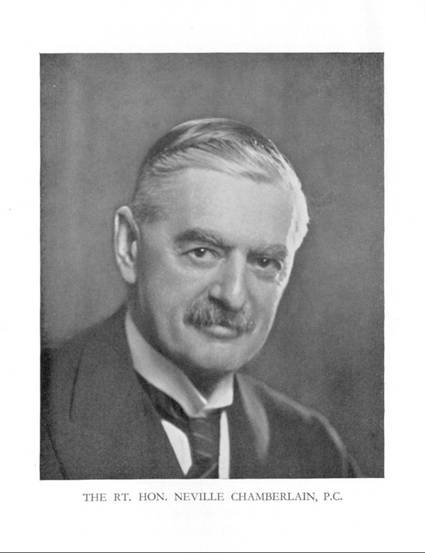
CHAPTER FIFTEEN
THE reign of realism in British foreign policy began with the advent to the Premiership of Mr. Neville Chamberlain.
It was he who, beyond all doubt, saved
Mr. Chamberlain is a man of great discernment. Although foreign affairs had not been his major study throughout his early political career, he brought to them that agate mind and unassuming courage which he had displayed in the years when he was concerned with the complex problems of a great and developing city and the later years when he was handing in a most difficult period the finances of the nation.
He was the first among his colleagues to denounce the midsummer madness of
continuing Sanctions against
We have had sufficient testimony of how highly both those leaders and their
people have appreciated his sincere personality. His three visits to
He is a man not to be "rattled." Neither the grim pressure of events nor the irresponsible criticism of ill-informed opponents has shaken, or can shake, his clear-minded determination. He knows the value of patience, and can smile when it is miscalled weakness. He knows the value of action, and—as the flights to Berchtesgarten and the recent new appointments to his Cabinet and staffs have shown—can take action without fuss.
He has always been frank about the aim of his policy. It is peace. He has
always been equally frank that the pursuit of peace does not mean the
abandonment of anything which truly affects
His effort is to understand the grievances of
This clarity of political vision would be of the greatest value in any statesman. In Mr. Chamberlain it is allied to qualities and faculties which, through long years of practical business experience, have been trained to the work of getting results without delay. That very lack of flamboyancy which to some eyes conceals his true greatness as the executive head of the State, is itself a valuable asset to the nation. It prevents his necessary actions from seeming provocative and theatrical. It impresses those about him, and those with whom he has dealings, with a sense of his sincerity that no amount of verbal protestations could create.
Mr. Chamberlain's tasks and responsibilities are greater than any that have rested upon his predecessors. For their achievement and endurance he is wonderfully equipped. But he needs the united support of the people behind him, and he deserves that support.
To complete the re-armament of Britain after the long years of neglect, and
the recent years of laggard and tardy experimentation, and at the same time to
anneal the wounds left by the last war and the twenty years' aftermath—those
are the two phases of his work. A strong
I say again, with all the emphasis that I can command, that we are fortunate to have a man of his mould and his character to carry the burden. The skirmishing Parliamentarians and the critics of Press and platform who for party or sectional reasons endeavour to harass and distract him do their country an ill service, or would do so were the Prime Minister and the public at large not at one in their realisation of the fact that at this time national unity is essential to national survival.
Mr. Chamberlain's policy is to keep the peace of the world. Peace may not always be in his keeping. If ever the evil day should dawn when peace is again shattered, the nation he leads, as any aggressor would quickly discover, is not without certain advantages. In preparing the British people against any such catastrophe Mr. Chamberlain knows well what these are.
The world would do well to examine them.
CHAPTER SIXTEEN
WHAT are
They are the basis for the real answer to the questions that we have been compelled, as a nation, to ask our-selves.
As I wrote six years ago, it is beyond question that the young Britisher makes the finest air pilot in the world.
Of this, I have no doubt. I have talked with pilots and air experts of all nations of the world. There is among them a consensus of opinion that it is the Britisher who has the essential qualities of the airman.
This may well come from long generations of maritime experience. There is, after all, some resemblance in the calls upon capacity and character made by the navigation of the air and the navigation of far seas.
The possession of this aptitude for the dominant arm of modern defence is of inestimable advantage.
The British are still unequalled on the sea. A mastery of nautical skill is not easily lost, even when a nation has grown persistently more urban with the passage of years. The Navy, the merchant service, the fishing fleets are still the nurseries of the best seamen in the world.
It is within living memory what we did in the war of 1914-1918.
There were no sturdier troops anywhere than those of the Empire, whether they
came from the pits and factories of
No nation in the world has a record of conducting war as our Napoleonic wars of twenty years duration were conducted, with dogged persistence and unfailing courage to ultimate and complete victory. I am sure that no other country, and no other people, has shown in such a high degree the qualities of our nation between the years 1795 and 1815.
These things are not matters of prowess only; they bespeak a true and real patriotism. In self-sacrificing and courageous love of country, the Britisher stands foremost. Our whole history proves it.
Equally does our industrial record demonstrate the same capacity and the same high standards of honour. British workmanship in industry has always led the world, both for skill and quality. It is as finished and thorough to-day as ever it was.
Commercially, despite setbacks due to political and other causes, the British are still the leaders of the world. An Englishman's word through the remoter countries acts as a talisman in all business transactions. It is a tremendous tribute to the real trust placed by others in our national qualities.
In emphasising this aspect of
Surely out of the compound of all these qualities as we have displayed them in the air, on the sea, and on the land, in arms and arts and trade, we can to-day fashion a nation secure from military attack and prepared for economic advance.
We do not lack patriotism, or initiative, or dogged industry. By getting together and applying our advantages of experience and qualities we can build a rampart that will withstand all that may be hurled at it in any future trial of strength, if such a trial there must be.
But—as I have said—I cannot see how this can be achieved without some measure of agreed compulsion. We force parents to send their children to schools at the public cost, but in regard to a much more vital matter we hesitate to apply compulsion to willing citizens in their own defence.
In manning the country in its defence we cannot rely upon a million scattered efforts or casual attempts to co-ordinate the efforts of small communities. The people need direction. They wish to be told what is expected of them and they will do it.
There is one other advantage enjoyed by
The Totalitarian States have one advantage. They have mobilised all the political resources of their people under one control, so as to be able to wage war or pursue prosperity with every predictable chance of success.
With them there is no division of opinion about what ought to be done; there is no stinting of energy when the task is known. There is no delay in beginning, continuing or finishing the work.
In the modern world, time is vitally important. We cannot afford delay. Without a strong central control delay is inevitable, as the pages of this book have shown.
With adequate resources of material and money, with men and women of the finest fibre in the world adapted by heredity to the very activities which will be the major uses of a modern war, with an Empire knit by a traditional patriotism to the British ideal of Government, we can be again the most formidable people in the world—so strong that none dare attack us.
From past perils must come a new resolution. With
The
Then can be made again with the old confidence the prediction, used by Mr. Chamberlain—
. . . come the three corners of the world in arms,
And we shall shock them.
But against a