and Falsifications of
Polish History
Else Löser
1982
Self-published by
[deceased]
--
PRESENTATION
(expanded in the form of a brochure)
Held in
1981:
at
Aumühle/Hbg., August;
the Steiermark, October.
Further events forthcoming.
“Just have the courage to state the truth openly and without
embarrassment! It will introduce doubt into the soul of the person listening.
Folly seeks flight when exposed to the air of doubt. You have no idea what can
often be achieved by means of a single word.”
Johann Wolfgang
von Goethe
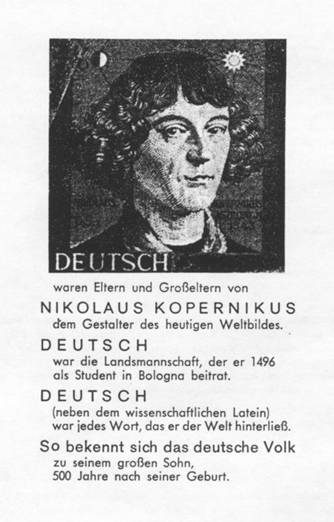
GERMAN were the parents and grandparents of
NICHOLAS COPERNICUS, the formulator of the modern concept of the cosmos.
GERMAN was the territorial association which he joined in 1496 as a
student in
GERMAN (in addition to scientific Latin) was every word he ever
bequeathed to the world.
THUS the German people salutes its great son,
500 years after his birth.
[p. 5]
With
regards to the theme of my remarks:
I would
like to begin with a few remarks about myself personally, for the purpose of
explaining why I am so familiar with circumstances in
I was born
and grew up in former Congress
I therefore
wish to make the Poles comprehensible to you in their cruel reality, in all
their doings. In so doing, I must also discuss the historical facts.
An evil
proverb referred to the eternal enmity between Poles and Germans and Poles has
existed among the Polish people for decades. The proverb states: Póki
świat światem, Polak Niemcowi nie bedzie bratem. In translation, this
means: As long as the world exists, a Pole will never be a brother to the
Germans — a truly malicious saying, which has no equivalent in
German-speaking regions. This proverb is an expression of the great vehemence
of Polish hatred.
What are
the origins of this merciless hatred? Is there any historical justification for
it? No, not at all.
Such
abysmal hatred is foreign to the German soul. On the German side, people have
always been prepared to build bridges and help in any way. This is a fact which
anyone can repeatedly verify, even today, when the same people who expelled us
from our homes and farms, who plundered us and even murdered many of us, seek —
and obtain — our assistance. The inefficient Polish economy is supported by
German assistance in sums running into the billions, while the German
population donates thousands of tons of food. Before me is a copy of a document
from the "Komisja Charytatywna Episkopatu Polski" from Kattowitz,
dated
Months have
passed since the letter of
But
Regardless
of these considerations, it must be observed that
The nature of the Poles is revealed by an incident, reported upon by the
Deutsche Wochenzeitung of
"History has handed down its negative judgment
about
And while
payment of German assistance was running full-tilt and our media were informing
us that this had already exceeded the sum of 22 million DM, we read the
following under the heading "Television Shows Anti-German War Films"
in the daily newspaper "Die Rheinpfalz" of
"Almost the only thing broadcast for
entertainment consists of war films showing the crimes of the Germans during
WWII. TV series about brave young Poles fighting the German Order of the
Teutonic Knights are even featured as weekly children’s programs. Almost the
only thing you hear on the radio is march music."
The
decisive battle against the Teutonic Knights took place in 1410. That was 570
years ago, but the Poles are still inoculating their children with hatred of
the Teutonic Knights, even today!
And we
thank them for their hatred with foodstuffs worth many millions of marks!
That is the coin with which the Poles have paid for German assistance since
the very birth of the Polish state. But when has a debtor ever loved his
creditor, especially when there is no possibility of repayment of the debt? We
Germans ought finally to take note of this, and act accordingly. The Russians
and French have never done anything for the Poles, and —
for this very reason – are not only not hated, but are respected.
We must
finally fathom the origins of this hatred in order to understand all the later
developments and false attitudes of the Poles for the Germans. We must finally
speak of the falsifications of Polish history. When were these committed and to
what purpose?
The Poles
today are a vain and arrogant people, especially the upper classes. They have
few gifts, they are not productive and creative, they
have given the world nothing magnificent. Because they were unable to develop
for long centuries, they developed negatively. Thus they made demands without
being able to produce services, they are greedy for the property of others, they think only of themselves and convince themselves that
they are the center of the world. There are no realities for them,
they live in daydreams and haughtiness.
The Poles
perceive their inferiority as a people but fail to recognize the reasons for
it. They think they are entitled to make demands, and these demands are made of
the Germans, instead of their real oppressors, who skillfully direct their
demands and their hatred.
Since their
conversion to Christianity, the people have been subject to a strict clergy,
which prevents the development of the personality. They cannot free themselves
from this straitjacket. They are kept down so much that they increasingly
unload their repressed aggression in unparalleled hatred against the Germans,
who are freer and richer. This hatred is once again manipulated by the clergy
and since the clergy represents the greatest power among the people, and since
the people trusts its Christian church, it also follows its leadership. The
Church triumphs in
In proof of
what I just said, I will reproduce a Catholic Polish battle song, which was
sung at the Pan-Slavic Congress in
"Brothers, take up your scythes!
Let us hurry to war!
Gather hordes about yourselves. Our enemy, the German, shall fall!
Loot and rob and burn! Let the enemies die a painful death.
He that hangs the German dogs will gain God's reward.
I, the provost, promise you shall attain Heaven for it.
Every sin will be forgiven, even well-planned murder,
If it promotes Polish freedom everywhere.
But curses on the evil one who dares speak well of
So rejoice ye all: Polzka zyje, great
and small!"9
[Alternate translation:
“Brothers,
pick up your sickles! Let’s hurry to battle!
Gather hordes all around you all. May our enemy, the German, fall!
Plunder, rob, scorch, burn. Let the enemy die
horribly.
Anybody who hangs the German dogs will receive God’s reward.
I, the Provost, firmly promise you the
I will forgive every sin, even premeditated murder
In support of a free
But curse the villain who defends the Germans among us.
Russian and
Exult gladly in it: Polzka zyje, large and small!”]
Every reader must feel the blood run cold as such diabolical hatred.
Poles nevertheless claim to be tolerant in religious matters, to safeguard
human rights and even that they struggle to protect them. Human rights is
understood by them to refer exclusively to the realization of their own
demands.
This song
has come down to us in the German language [Translator’s note: this is
undoubtedly true, since it rhymes perfectly in German; for example, “Fluch dem
Bösewicht, der vor uns für Deutschland spricht”, i.e., “Curse the villain who
defends the Germans among us”] This proves that the Poles, the so-called
“original Slavs” with the “Slavic”-Polish past, were still using the German
language predominantly in 1848, because their own language was not yet very
strongly established at that time. They also wanted to reach all Catholics,
since they always claim that Catholics and Poles are one and the same.
At this
point, I would like to refer to an event which was just recently rescued from
oblivion by German publications—the Polish revolts of 1830 against the Russian
oppression. The revolts failed, the Poles fled in great hordes and were
lovingly received and cared for—where do you think? Why, in
The report
repeats the description of a reception of the Poles on
“Hardly
was the news received, late on the 18th, that the Poles were arriving in
Neustadt the next day and would spend the night with us, than there was great
excitement. They consulted on the type of reception they were to be given and
the manner in which these highly honored guests were to be welcomed.
“....
The Germans were soon cheering the victorious Poles of 29 November,
soon German and Polish tears were flowing into the wine of the
To me, what
is significant about this report is not only the sincere welcome given the
Poles by the tippling Pfalzers, but rather, the fact that they communicated
with each other exclusively in the German language, since the Pfalzer could
only have sung along if the Polish songs had all had German texts at that time.
To me, this is further indication that the hateful Polish Catholic battle song
of 1848 was written in German. The German friendship and sympathy with which
the Poles were received were repaid by the Poles, only a few years later, with
abysmal hatred. But that was nothing new. Efforts had already been made to wipe
out everything German on earlier occasions as well. Thus, even in the 18th
century, Catholic Bambergers who had immigrated after the Black Plague,
following their bishop, were Polonized by force: they
were refused religious services and catechism in German and were re-educated as
Poles. By the time of the First World War, these Bambergers were so Polonized that they could no longer speak German — despite
their German Bamberger costumes, which they still wore, and as a result of
which they were still called “Bamberki”.
This was
the Polish religious tolerance, to which the Poles so proudly refer whenever
they can. The Catholic Polish battle song of 1848 is not the only example of
clerical hatred. These existed, and continue to exist, in such great numbers
that one cannot list them all. I only wish to quote a few. From the text "
“On
“On
And Peter
Aurich, in his book, "German-Polish September, 1939" wrote as
follows:
"... after the Cracow newspaper ‘Czas’ had
gone so far as to announce that ‘Poland’s artillery is aimed at Danzig to
protect Poland’s honor’, not a single Sunday went by without ‘holy war against
German neo-paganism’ being preached from the pulpits, and prayers were said for
the victory of Polish arms."
And on page
47 he says:
“Colonel
of the General Staff Switalski, in the name of the Polish army in Graudenz,
gave a speech at a reception for bishops Dominik and Dr. Okoniewsld, concluding
with the words: ‘Pray with us today .... so that our
brothers may hold out, that their probationary period may be shortened, and so
that a great deed – a second Grunwald, may liberate us from lack of freedom and
ensure us a corresponding peace.’"
Grunwald is
what the Poles call the Battle of Tannenberg, which broke the power of the
Teutonic Knights in 1410. In this regard, you need to know that there is no
place called Grunwald. The battle took place in the vicinity of the
There was
also an earlier massacre at Bromberg, on
The peak of
hatred however was reached by the cathedral canon, Prelate Kos, who, during a
victory celebration of the Polish National Democratic Party at the triumph of
“Wherever the Germans sets
his foot, the earth bleeds for 100 years. Wherever the Germans carry water and
drink, the wells putrefy for 100 years.
“Wherever the Germans breathe,
the Black Plague rages for 100 years. Wherever the Germans extend their hand,
peace goes down in ruins. And if you were 100 years old, the Germans would be
ready to deny it.
“He deceives the strong, robs and dominates the
weak, and if there were a road straight to Heaven, he would not hesitate to
dethrone God. And we would then have the experience of seeing the Germans
stealing the sun from the sky.”
This can
only have been written by somebody whose nature bears hatred inside, whose
entire life is eaten up by hate and envy. If he were not such a sick-minded
hater himself, how could he generate such inhuman thoughts? A normal person
doesn’t think this way. But that a cathedral canon, a worthy prelate, should
repeat this song of hatred against the Germans at a victory celebration 20
years after it was first poured out by this “poet” is monstrous and proves most
effectively that the outbreak of hatred of the people was controlled by the
Polish church. The song of 1848 “Brothers, Pick Up
Your Sickles, etc.”, is, after all, of “Christian” origin, and was sung well
into Korfanty’s time, i.e., the 1920s.
Let us now
investigate the testimonies of hatred of the Polish intellectual classes, which
are a result of this ecclesiastical incitement since 1848. Local historian and
scholar in Polish matters, Alexander Treiche, in his book, “History of German
Culture of Rippin [
“In the years of revolution, 1904 to 1906, we were
always hearing that all Germans ought to be slaughtered in a single night. To
slaughter the Germans from the cradle upwards was the slogan of the Poles at
that time. But even in the time when our parents and grandparents were still
children, during the 19th century, they often heard this horrible
slogan about the slaughter of all the Germans, with which the Poles had
obviously been indoctrinated for generations."
And then
there are the publications from the year 1929 in the Polish newspaper
"League for Great Power", third edition:
“In war against the Germans, there will be no
prisoners and no room for human feelings. We will astonish the world with the
unusual, the bloody victims exceeding human proportions with which we will wash
away the shame of the insults which we have had to endure from the Germans. In
the Polish army, we must bear the spirit of an irreconcilable struggle rising
to the point of cruelty."
And on
“The struggle between Poles and Germans is
inevitable. We must prepare ourselves for it systematically. Our aim is a new
Grunwald, but this time a Grunwald in the suburbs of
“Prussia must be re-conquered for the Poles, and we mean
“From this very day onwards, every issue of
this paper will be dedicated to the coming Grunwald in
In March
1939, my brother, in a night club in Bromberg, heard Polish officers talking to
each other about how they would “wade through German blood” in the event of a
war with Germany. The lists with addresses of the Germans were already
prepared. He had no idea that he himself would fall victim to this murder lust.
And in
January 1945, when the Russian advance was approaching Litzmannstadt (where I
was staying at the time) the Polish slogan was:
“Reich
Germans, pack your bags,
Ethnic Germans, prepare your coffins!”
And my
family paid for these blood-thirsty words with their lives. Except that they
were no longer alive to buy any coffins.
The Poles
weren’t just anxious to shed blood in 1939 and 1945,
they began immediately after the creation of their new state. The bloodiest
rebellions raged in
“With
this broom we will sweep the last Germans from
Any that are still there in July 1921 is German trash and will be slaughtered
to a man, and the biggest Hakatists [ethnic German Catholics] will be covered
with petroleum and tar, set on fire and burned… .
Now they’ll all going to get it... all doctors, pastors,
lawyers, leaseholders, settlers, property owners of all kinds, whether German
or Jewish.”
There are
also enough admissions of endless Polish covetousness. I only wish to quote a
few:
On
“The safest tanks in Pomerelia [region of
eastern
On
“Danzig, too, is a Polish city and will be
ours. Your duty is to conquer
In 1937,
the [Polish] General Staff officer [Hendry] Baginski, states as follows, among
other things, in his book, which is constantly being republished:
“Until peace reigns in Europe, until the name
of Prussia, which is after all already the name of a people which has long
since disappeared from the map of Europe, has been wiped out, until the Germans
have shifted their capital city Berlin further to the West.”
A Polish
General Staff officer reveals quite clearly here the Polish lust for war and
the objective of that war: the incorporation of
In reply,
we must ask: on the German side, did any body ever express any desire or demand
to shift
The
Pan-Slavic Youth Association on
“In 1410, the Germans were defeated at
Tannenberg. But now we will smash them at
The Polish
Professor, Limanowski, from Vilna, was right when he said of his countrymen:
“It lies in the nature of the Poles that they
cannot remain in the realms of the real; their fantasy reaches further; whenever
they get this hands on a piece of land, they want more. They want the whole
world.”
In fact,
they do want the whole world.
In June 1929, they gave further proof of it:
"The hour of freedom will soon ring for
the historically Polish territories. The ‘Pax Polonica’ will cause
The manner
in which
".... We have carried out territorial
gains in the West in a previously unprecedented manner – the easiest and most
favorable: we have acquired territories in which streets, railways and
waterways were already available as well as cities, which only await
settlement, industrial installations, which only await activation, and coal mines. There are also a few
residues of the German population which will be liquidated in a short time, in
the manner that suits us, as we are morally and legally entitled to do under
international law."
Next to
megalomania, what is recklessly revealed here is the Polish lust for robbery
and murder, which breaks out in this people over and over again. The most
shocking thing is that this Minister of Industry, the same one who wants to
liquidate the residues of the remaining German population at whim and who
constantly brags that they are entitled to do so under morals and international
law, bears a German name.
He is
obviously a German, “re-educated” for centuries, as in many other cases as
well. The Poles call that "a German having risen in the
Polish culture". An old proverb, a few centuries old, confirms this
over and over, that men of our blood who leave their country [and] apply their
strength and skill to another people, are lost to us. They not only become
loyal citizens of their new country. Vanity and a need for validity drives them to become our bitterest enemies in two or three
generations – sometimes even faster. For the most part, they do valuable
cultural work, which the host peoples benefit by, but they themselves become
renegades, culturally enriching other nations. Renegades always carry the
poison sting of treason, and precisely for this reason, they become worse
haters of their ancestry than if it were truly foreign to them. There are
endless examples of this turncoat attitude in all countries of the world. The
best known deniers of their German blood were after all, Catherine the Great of
Russia, the princess from
Let us now
turn to the history of the origins of
The Poles
are a very young people without origins of their own, created, as it were, in a
test tube. They received their land from the Germans, their language from
Glagolitic monks [followers of the Greek monk St. Cyril, inventor of an
alphabet for the Christian conversion of Slavic tribes], working on behalf of
We should
not ignore or underestimate this Polish reference to their own race, since here
the Poles themselves give an indication of their origins of the Polish people.
We already
know that the Glagolitic church language of the bishop of
From the
present situation, we know that victors never withdraw immediately after the
end of the struggle. They remain in the land to enjoy the fruits of their
victory and especially the women, in order to rape them and destroy their
racial integrity. The hordes of robbers at that time did the same as they did
in 1945, when they fell upon us and our people, especially our women. This was
just as calculated, as it is today in the Pan-European idea of Count
Coudenhove-Calergi [a racial mongrel who became famous in the 1920s]: a
mishmash people that can more easily be ruled.
When the
Poles, in their official history books, openly admit that they learned their
lust for war from the Tatars and took their costumes from the Turks, then they
are admitting that they are also racially related to the Turkish Mongols.
Because only somebody of related blood could adopt a cruel, bloodthirsty method
of fighting as his own and even brag about it. Only when it reflects one’s
inner nature, can one say: plunder, rob, scorch, murder, let
the enemies die horribly! There is not a single example of this type, down
through the centuries to the present day, of German soldiers and priests
talking this way, because it does not reflect their nature. On the other hand,
we have many such Polish admissions. This shows the
late consequences of this mixture of blood with Asians, which was introduced by
the anti-German clergy with their policy of de-Germanization. This reveals the
time of the origins of the Polish people. It reveals itself so clearly and in
history that we must ask with astonishment why it even required these Polish
admissions to be able to recognize these facts clearly. We are grateful to the
Poles for opening our eyes in this manner.
The seed of
the bishop Kadlubek nevertheless did not grow so
quickly as intended, because, until well into the 15th century, the
new artificial language was unable to prevail. Precisely the citizens of
But the
German East never belonged to the Asians, it is clearly a German settlement
area, even if Turks and Asians temporarily flocked there and left traces. They
contributed nothing to construction or culture. All attempts of the Poles and
their foolish or treasonable German helpers, to refer to the German areas
occupied by the Poles at that time as “originally Slavic settlement
territories", must be decisively rejected, since they are obvious
falsifications.
The Poles
have represented the thousand-year celebration of the Christian conversion of
the regions on the Weichsel, Warthe and
Richard Suchenwirth,
in his work, The German East, reports on the development of the German
Eastern territories. These are excellent reports.
But the
author makes false assumptions based on the notion that there were both a
Polish land and people, without ever asking where they came from and what their
origins were. He describes the whole process of settlement as having been
carried out by Germans, with great displays of erudition, and repeatedly says
that there is no proof that the wars fought at that time were between the two
peoples, but were, on the contrary, purely religious struggles and wars of
Christian conversion, but nevertheless assumes the existence of a Polish people
without offering any proof of it. This is how stubbornly historical
falsifications have become established among us. Suchenwirth’s book isn’t the
only one on the subject. To learn how much has been falsified, erased, omitted
and added, you have to read "The Falsification of German History" by
Wilhelm Kammeier and the "Slavic Legend" by Lothar Greil. They
really open your eyes.
First I’d
like to describe what we were taught about early Polish history when we learned
it in school. They begin with the Christian conversion. Today, the Poles give
an entirely different date for it. But let’s begin with [one of] the early
rulers of
This novel,
"With Fire and Sword" plays the most important role in the
lives of all Poles who base their knowledge of history of the people and the
intellectuals on this chauvinistic novel. Furthermore, the orders of knighthood
are equated with the Germans.
In truth,
however, the orders were never subordinate to the German Reich or Emperor; it
was an independent body in the service of the Pope. Members were exclusively
Germans from the Reich, but their sole function was to protect the interests of
the Catholic Church, as demanded by the Catholic faith generally at that time.
Their wars were wars of Christian conversion and not wars between Germans and
Poles, which didn’t exist at the time.
The Poles
are always talking about their victory at Grunwald in 1410 against the orders
of knighthood, in which they are said to have been the conquering heroes. In
fact, they only achieved their victory through the unparalleled and
unscrupulous treachery in the ranks of the order itself.
[This section was problematic, as it was
difficult to understand the nature of the claims being made. Deletion of text quoted by
Else Loeser; substitution of text by Bolko Freiherr von Richthofen and Robert Reinhold Oheim:
“Their
[the Teutonic Knights’] heroic struggle against superior numbers was
weakened by treachery and treason at the decisive moment. The “Union of the
Lizards”, mentioned above, fighting as a closed, armed company, within the
Order of the Knights, by the Polish baron Mikolaj z Rynowa, a knight of the
nobility of Chelm, disguised under the name of “Nickel von Renys”, violated
their oaths, together with the companies of the knights from the local Prussian
landed nobility, by betraying the Knights at the decisive moment, lowering
their banners as a sign of surrender, and deserting to the Poles en masse.
On the other hand, many Poles remained with the Knights and fought faithfully,
such as, for example, Konrad von Oels, who ended up as a Polish prisoner.”
—From p.
132, POLENS TRAUM VOM GROSSREICH, by Bolko Freiherr von Richthofen and Robert
Reinhold Oheim, reproduced as volume 1 of the 3-volume set, DIE POLNISCHE
LEGENDE, Arndt-Verlag, 2001, D-24035 Kiel, Postfach 3603.]
[According to Wikipedia: “A pivotal role in triggering the Teutonic
retreat is attributed to the leader of the banner of Culm, [1]
[2] Nikolaus von Renys (Mikołaj of Ryńsk),
born in Prussia (identified by Longinus as Swabia, a name used
by Poles for Germany). The founder and leader of the Lizard
Union, a group of Order Knights sympathetic to
A shocking example of treason, envy and desire for revenge, which is
unfortunately not unique in German history, leading, then as now, to such
devastating disaster for
But the
highest Polish “Christian" dignitaries always
talk about this "Grunwald", which is however called Grünefelde, which
gives them more glory but which they turn into the opposite with lies, in order
to portray themselves as innocent martyrs.
The
so-called offer of reconciliation of the German bishops of
"...His
theses were directed against the German Orders of knighthood, the so-called
‘Crusaders’, which at that time, in the Slavic North and in the Prussian and
Baltic countries converted the original local inhabitants with fire and sword
for European Christianity and for its symbol, the cross, and for the church, in
whose name they appeared, over the course of centuries became a fearful and
extremely compromising burden. Even today, after many generations, the
designation ‘Krzyzak’ (Crusader) is an insult and bogie man for every Pole and
is unfortunately all too often identified with German culture. From the
settlement areas later came those Prussians who
brought everything German into ill fame in the Polish lands. They are in
represented in the historical development represented by the following names:
the same Albrecht of Prussia; Friedrich, the so-called ‘Great’;
In their
hatred of the Germans, the pious gentlemen even forget that they are accusing
their own Roman Church and Popery by stating that the conversion of the
original inhabitants in the Prussian and Baltic lands with fire and sword was a
compromising burden for European Christianity and its symbol, the Cross. This
type of conversion at the time was quite common and occurred with the knowledge
and approval of the See of St. Peter, in this case at the special wish of the
Duke of Masovia, of whom the claim is still made, by Poles, that he was a
Polish Prince. He called upon the knights because he had too little “fire and sword”
to subjugate the Prussians. This illustrates the manner in which hatred makes
people so blind that they can no longer think logically. But these remarks of
the Polish bishops also reveal something else, namely, that hatred against the
German orders of knighthood was unleashed by the Poles and is carefully
cultivated by them. History is deliberately twisted into its opposite, because
people want to ensure endless hatred. Because this so-called "Message of
Reconciliation" was not only directed at the German recipients, it was
also intended for their own people as proof of the kind of monstrous and
shameless language which may be safely indulged in, against the Germans of the
same rank, by their brothers in the faith. This shows quite clearly who is responsible
for the education in hatred. There are endless examples in this, as well as
other, additional, letters from Polish bishops to German bishops, revealing the
lack of truthfulness in relation to past and present. At the same time, the
Christian priesthood in particular had reason enough to extend the mantle of
forgetfulness about the atrocities committed during the Christian conversion of
Europe – and not only Europe. For example, was
These
examples show clearly that behind the stubborn clinging to historical lies
stand special objectives which can been glimpsed over
and over again, like a red thread.
At this
point I would like to add some remarks on the effects of such historical
falsifications down to the present day. In May 1981, the ZDF broadcast a
three-part series under the title “Scars”, which was billed as an attempt at
German-Polish reconciliation. The content was one single distortion of the
actual circumstances. Extensive detail was given on the final discussion
between the German participants Philipp von Bismarck and Countess Dönhoff on
the one hand and the Polish professor Wladyslaw Markiewicz and the journalist
from the
“The
historical consciousness of the Polish people is not formed by historians and
scholars, but by their great poets and writers, Adam Mickiewicz and Henryk
Sienkiewicz.”
And it was
easy to see that he was proud of this. He was so proud of his poets and his own
cleverness that he forget how he himself, as an historian, is damaging his own
reputation and that of his people. This is just another example of what Prof.
Limanowski once said about his countrymen, that they cannot remain in the real
of the real. Historical reality is not reality at all for them, but rather, the
Polish daydreams of their own greatness and infallibility and German brutality
and the cruel oppression of the poor, helpless Poles, who are supposed to be so
proud.
This also
shows how nonsensical it is, to sit down and negotiate with such people on a
school book commission. What is this supposed to accomplish? Certainly
not historical truth. Neither the professors nor the Polish cardinals
have any knowledge of these things, and, accordingly, neither do the Polish
people. The only purpose of the Polish school book commission is to establish
the Polish version of events for all time, just like the historical
falsifications that were spread about in the past. And this is a question of
billions of marks, which are to be extorted by means of German admissions of
guilt.
But back to
Mieszko I. Who was he? Was he a Pole? No, although the Polish cardinals claim he
was, in their so-called Message of Reconciliation, falsifying history from the
very first page:
“It has been irrefutably proven that, in the
year 966, the Polish prince duke Mieszko I, as a result of the influence of his
wife, the Czech princess Dombrowka, received the Holy Sacrament of baptism with
his royal household, as the first prince.”
Historically,
the truth is quite different, and the pious gentlemen are lying. The name
Mieszko is derived from the surname Mesico, of the Norman prince Dago, from the
very highly respected family of the Daglingers, from the
Prince
Boleslaf of
Dago’s
son, Bolsleib the Clever, married the daughter of a Viking prince. The Poles
turned him into the “first Polish king”, Boleslaw Chrobry. Neither the Norman
prince Dago-Mesico nor his son, Bolsleib the Clever, was a Pole. Dago-Mesico
founded his new empire in the thickly settled Germanic territory on the
Weichsel and Warthe, documentary records of which exist as the Mesico-Reich. He
ruled from 960 to 992. Despite indisputable research findings, the past of
After
the incorporation into the territory on the Weichsel and Warthe, Dago-Mesico
attempted to expand his kingdom through conquest. But he suffered defeats at
the hands of the Vandals in
When
the Polish bishops indicate in their text "We Offer Forgiveness - We Ask
For Forgiveness" of the Polish hierarchy with the first archbishoprics in Gniezno
and three assistant bishoprics of Crakow, Wroclaw, Kolobrzeg – however Cracow,
Breslau and Kolberg might be called – we must object that they are telling
untruths and are falsifying history. There was a Polish hierarchy, but all
bishops, all members of the orders, and all monks were Germans from the Reich
territories. Where is any Polish hierarchy supposed to have come from? The bishopric of Gnesen was entrusted to the German bishops Jordan and
Unger and were dedicated to the holy Adalbert of Prague. So who founded
the Polish hierarchy?
Towards
the end of the reign of the Daglingers in 990, Dago gave his empire to the Pope
and withdrew as a fief against the payment of tributes. From this point onwards
begins the evil development which was to lead to the formation of the
anti-German basis of
We
can skip the intrigues and struggles between the sons and nephews of the Norman
princes of Dago-Mesico and the Roman Church, no matter how they may be in
themselves. The Roman church reinforced itself through the Christian conversion
of the remaining areas of the Mesico Empire. This did not of course take place
as a result of the voluntary submission of the Germanic tribes, but through
violence and war. For the inhabitants, there was only one choice: baptism or
death. There were struggles between pagans and Christians, but never between
Germans and Poles.
The
pagans were called “sclavi” at that time, i.e., because they were considered
the “slaves” of a pagan god. After they underwent baptism, they were
Christians. The word “sclavi” lost its meaning and was forgotten. Only in later
centuries during the translation of Latin texts did people stumble across this
word and forgetting its original meaning they removed the “c” from the word
“sclavi”, because the deprecatory word “sclavi”, which reminded them of
ordinary slaves, was perceived as an insult by the persons concerned.
At this
point, I would like to insert what D. Skobnol says on
this topic:
“Only at the end of the 18th
century did German outsiders invent the more refined concept of Slaven. By omitting the refined
"c" – or "k" – they retroactively falsified sclavi (from monkish Latin), as well as Sklabenoi (from late
Greek). As ‘sklavi’ = servants, Gotzdiener, and worshippers of Satan was a word
used by theologists, scholars and chroniclers of the West Roman, and, later
German Reich, from the 9th to the 11th century to refer
to all remaining masses of not-yet Christianized Germans serving ‘pagan’,
nature or polytheistic cults, on the other side of the Christian West Reich;
i.e., (more or less) about east of the Elba and north of the Danube, and, of
course, deep in later ‘Poland’ referred to as the Easter territory, and as far
as the Baltic. The word ‘Sklabenoi’ = i.e., Götzendiener, devil worshippers,
was understood to mean, during the same period – from Byzantium,
Constantinople, i.e., to the Eastern Empire (Greek Empire), all the many
‘pagan’ Germanic and related Indo-Germanic peoples dependent on not-yet
Christianized [people] of Turkish origin in huge areas east of the borders of
the Christian German Eastern Reich; i.e., (more or less) the central and eastern
regions of the Balkans and, in particular, the land mass from the Black Sea to
the Urals and Baltic (later, the Ukraine, Russia, Lithuania). Paid historians
of the 19th century did not hesitate to falsify documents from the
ground up, by erasing the tell-tale ‘c’ from the documents made available to
them with special tools and artificially changing the sequence of the letters.”
How
magnificently they did their work is described by Wilhelm Kammeier in “The
Falsifications of German History”. Something similar happened with the name “
The
same applies to
After
these inserted scholarly concurrent remarks of all present researchers in this
field, I would like to continue with my prior remarks.
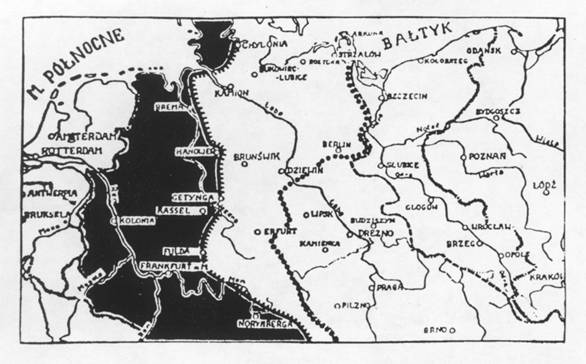
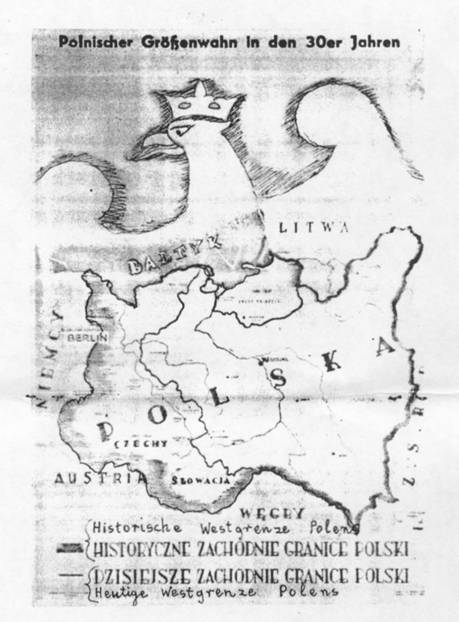
This map was the object of mass distribution both inside and outside
The map shows the insane chauvinism with which the Poles demand their “historically
Polish western border”, even today. According to the map, entire regions of
what are today
Polish chauvinists, emigrants and Bolsheviks all share this megalomania.
The map shows, as a motto, the slogan of the Polish poet Adam Mickiewicz:
"And every one of you, in your soul, bears a seed of future rights and a
measurement of future borders!"
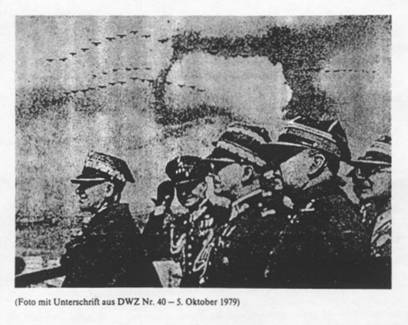
They thought they could conquer the German Reich all by themselves.
This
Polish propaganda photo shows Marshall Edward Rydz-Smigly in a victorious pose.
He thought he could conquer Germany all by himself and then march on to
Another
piece of fake photographic "documentation" intended to convince the Poles
themselves that they were all-powerful.
The wars of
Christian conversion decimated the Germanic population. But the monks wanted
support points, i.e., they needed to built cloisters,
but there was no work force. Prior to the Christian conversion there were
flourishing landscapes, but afterwards, they fell into ruin: ruined
fortifications, settlements and courts overgrown with grass, hay and trees.
Churches and nobility sucked the blood of the lower folk. Artisanship no longer
existed, nor did merchants. The mass of the "local
population" sank in numbers from year to year, while the rest were reduced
to slaves, or serfs.
In
order to be able to build cloisters, the Cistercians had to procure a suitable
supply of people, and they came exclusively from the territories of the German
Reich. The monks assured the new settlers of privileges of all kinds and gave
them German laws. This brought the desired success. German villages soon
surrounded the cloisters. Christian immigrants reinforced Christian power. The
Reich, on the other hand, allowed its citizens to be drawn out and did nothing
to ensure possible rights for them. They made no attempt to incorporate the
settled and cultivated areas, which were now settled exclusively by Germans
from the Reich, into the Reich, in contrast to
The
work of the settlers bore rich fruit. For the most part, they brought money
with them, they gave the land order and right, custom
and education. In the desolated land, after the construction of the cloisters,
the swamps were drained, forests cleared. Wasteland and moors were made
cultivable. Dams were built, moats dug, canals and bridges built. Instead of
the old huts of mud, houses were built with baked brick and mortar. The German
farmers brought their mouldboard plows and introduced crop rotation. The wealth
of the land grew steadily. There arose gradually the granaries of
That
these areas had once achieved a high level of culture in every respect, is the
best proof that they were German, and that they could not have been Polish,
since they would never have achieved such a flourishing level of prosperity
after the repeatedly provided proofs of Polish incompetence.
With
the assistance of the Cistercians, artisans also settled the Mesico-Reich.
First in the field were cloisters, then also outside the cloisters as well.
Thus arose the villages and cities, the guilds. There
followed the patricians and great merchants from the Reich, trade flourished in
the land on the Weichsel and Warthe. Until well into the 15th
century, Germans represented the largest part of the nobility and prince
bishops, the settlements were subject to them, they founded not only cloisters,
but trade centers as well. German was the lingua franca and the writing was
German and the names were German, the laws were German. The Cistercians also
possessed the privilege of only accepting citizens of
The
Poles have never, for example, contributed to the construction of this territory
on the Weichsel and Warthe, since, first of all, there were no Poles yet, and
secondly, when there were Poles, they were never capable of doing so. The Poles
are not a creative people, but a people oppressed and held down by the clergy which cannot develop or even maintain land which has been
given to them or which they have conquered. We are experiencing this problem at
the present time, and not only agriculture in the former German eastern
territories, but in industry, mining and trade as well, which were totally run
into the ground in only 35 years, that which took centuries to build up. The
reason for this lies not in Soviet oppression, but in
the incompetence of the Polish leadership classes.
The
areas on the Weichsel and Warthe were legal possessions of the German orders of
knighthood. In the struggles for the Christian conversion of the Prussians, who
resisted bitterly, Duke Conrad of Masovia obtained the assistance of the
orders. After initial hesitation, the order was prepared but only upon promises
of return payment. This return payment consisted of expropriation by the Duke
of all of the
The
Poles however completely distort all this land expropriation. Otherwise they
would have to admit that – if they had even existed at that time – they broke
this treaty, when they expropriated this land by violence. Without this expropriation
treaty, they describe the German orders as violent invaders, against whom they
defended themselves as they had a right to do. Already this false description
of history, even in German history books, shows the evil effects of historical
falsifications. That struggles between pagans and Christians could be
represented as struggles between two peoples and legally executed land gains
could be passed over in silence, has made formerly racially related people into
deadly enemies over the centuries. Was this intentional? Unfortunately we must
answer yes. Why was this?
In
all marks of the struggling princes people spoke German in the various German
patois and dialects, since all princes and kings and their wives were of German
origin, all bishops of the Beneficiation Churches of Gnesen were German too.
The Pre-Monstratensian and Cistercian monks were all recruited out of the Reich,
and to a man, the upper classes were all German and all settlers were German.
But the Pope in
Thus
he looked for ways to prevent this. In so doing, the bishops from Engelsburg
offered the necessary assistance, while they, for their part, could count on
the following of the monks and lower clergy. They found the way and they found
the tool.
At
this point I would like to quote a paragraph from the "Slavic Legend"
by Lothar Greil, describing the birth of the Polish people and country. It was
really a test tube baby type of situation:
“The most important objective was
to erase the connection between the settlers and the former country. But
because there was absolutely no cohesiveness in the provinces of the Mesico
Empire, with its fragmented leadership, which was only held together by force,
they set out to lay the basis for a unifying national and patriotic idea.
Anybody who lived in the border areas of the territory of sovereignty of the
senior council gentlemen of Cracow, a claim which is still made today, was to
be taught that there was no national, political or ecclesiastical commonality
with the other Germans living in German culture. With the approval of the
Curia, Vinzenz Kadlubek – since 1208
Bischop of Cracow – in 1218 in the enclosure of a cell in the Cistercian
cloister of Klein-Morimund (Andreöw) and wrote there his ‘Chronica Polonorum’
in the Latin language. This man, who, as a German, was really called Wolf
Gottlobonis (i.e., Wolf, Son of Gottlob), invented the concept of ‘Poland’ as well
as the saga of the ‘Lechs’, the so-called ‘original Poles’, and their ‘Piast’
family of princes. This imaginative work is chock-full of inventions and
statements in contradiction to the facts, but this does not prevent it from
being of enormous importance as propaganda. Of course, later, nobody dared to
call a Christian bishop a swindler and a liar. And because a ‘Man of God’
always tells the truth, not even educated intelligent men thought of attacking
the credibility of this ‘testimony’. In this manner, one of the most
astonishing historical lies became a historical taboo. Although long since
relegated to the status of a fable by all serious researchers as a result of
the absurdity of its content, Kadlubek’s text still forms the basis, not only
for all Polish, and even German, historical writing in this regard. Everybody
repeats the fairy tales and blabs about the ‘Pole’ who didn’t exist at that
time, any more than any concept of a Polish state, the ‘Piasts’, when people
talk about Dago or his descendents, and, of course, about the ‘Slavs’, who are
supposed to have resided there, instead of the actual Germans who were there on
the spot, in what is called Poland today. That exclusively German dialects were
spoken in all provinces of the Mesico Empire, even in Vinzenz Kadlubek’s
lifetime, which could even be understood by anybody from western Germany, is
ignored and therefore largely unknown.
It
nevertheless took a long time for the new language to be accepted and
recognized by the people and nobility. Until well into the 15th
century, it was unable to take root. It is an undeniable historical fact, that,
for example, the city of
These are
the biggest cities in
Although
there is no historical proof at all, the Poles represent their history as if
they could look back on a thousand years of existence of a Polish state. And
the otherwise serious Germans help them in so doing, sometimes intentionally,
sometimes unintentionally. The first falsifier, as we have heard, was the
German, Wolf Gottlobonis, active as bishop in
The
Poles naturally need to fill out their alleged thousand-year history with great
events and great men. Since no such great events or great men ever existed, they
simply allocate to themselves all the great Germans they can find, and describe
them as Poles. I will only mention a few, the most outstanding, those that the
whole world knows were German; the Poles nevertheless dare to list them as
Polish. The Poles prefer to make themselves ridiculous than admit the truth. As
long as they can brag, they figure sometimes they will be believed.
Nicholas
Copernicus! Because this great man was born in Thorn on the Weichsel and Thorn
is called
Greece and Rome are no more, they only exist through Homer and Virgil, so
let
I took this
documented megalomania of the Poles and arrogance from the brochure by Rudolf Trenkel, my countryman from Thorn, called "
The
German astronomer, Johannes Hevelius, too, because he was born in
Same thing with the sculptor, Veit Stoß, from
But
there were also Poles who knew full well what they owed
“My pride is completely silent when
I think that not we, not the Poles and not our efforts led to this gigantic
upset. People are able to greet me with cannon salvos today in
Later
he even told them once:
"What have you done with this state? You’ve made it an object of
ridicule."
We
must remember that the
In
order to understand the connections, the historical developments must be
recalled from forgetfulness.
"...Our troops, and those of
“...I hope that the present
occupation of the Polish borders to the East will be the beginning of a development
which will eliminate the old conflicts between Germans and Poles and lead the
country from the Russian yoke into a happy future, in which the nature of its
national life will be cared for and able to develop..."
And
the solemn proclamation in the old royal palace at
Even
the telegram of thanks to Kaiser Wilhelm II and Kaiser Franz Josef I dated
"On this day, when the Polish people declares, that it is free and will receive an
independent state with its own king and government, the breast of every
freedom-loving Pole is filled with a feeling of gratitude towards those who
freed the country with their blood and led it to the renewal of its independent
life...
“We are therefore sending our
thanks and our assurance that the Polish people will be able to maintain the
faith with its allies..."
(Quoted from
"Enduring Hypocrisy" by Kurt Relle.)
Polish
gratitude evaporated so quickly that in 1922 Pilsudski was compelled to remind
the Poles that it wasn’t the Poles that brought about this tremendous
development. Gratitude and faith to those who purchased
The bloody
terror in
"The outbreak of the First
World War awakened the hopes of the Poles... in 1915,
German and Austrian-Hungarian troops occupied the areas annexed by
“On
“A few days after the formation of
the government, partly through armed struggle, the Germans were driven out of
“In the final phase of the war,
seven well-trained and well-armed Polish divisions were fighting against the
Germans on the Western front under the command-in-chief of General Josef
Haller."
This
description is a lie from beginning to end. Neither the Central Powers nor
Lenin did anything for the resurrection of the Polish state. Neither the
Central Powers nor the other new masters (!) of the Polish areas plundered or
robbed, or destroyed industries or kidnapped hundreds of thousands of Poles for
forced work. And Josef Pilsudski was never in a German prison, and therefore
could not have been freed from one. Pilsudski spent time in Russian prisons and
in
In
the confusion of the collapse in 1918 the Germans brought him back to
Nor
did the Germans have any reason to destroy Polish industry, since they wanted
an independent
This
pack of lies also mentions “well-armed Polish divisions”, alleged to have
fought against the Germans at the final phases of the war, under the
command-in-chief of General Josef Haller. In reply I would like to cite the
periodical "Waffenjournal", to show who this general really was. The
periodical reports that in 1918, after the restoration of
At
this point I would like to mention other Generals of German ancestry, for
example, General Anders, who formed an elite troop of large numbers of locally
resident Poles in
The
periodical "Waffenarsenal" also reports, that at the outbreak of the
war in 1939, in
The
Poles ignore everything favorable to
In
this book, all the work of construction, all the services of the Germans are
attributed to the Poles, since they happened, after all, under Polish kings.
And still they brag about a very high level of culture. They lie so openly, as
in the case of Linde or Veit Stoss, they just camouflage it a little, by saying
“the three-field system was introduced under King Kazimierz Wielki and the
first stone houses were built”. Kazimierz Wielki is said to have taken over a
wooden
Precisely
that which affects
That’s
why this 700-page tome is not as harmless as one may perhaps assume. Because only people with a very good knowledge of Polish history
can recognize all these lies and distortions. The lay person of good
will, especially the gullible Germans, who cannot imagine the extent to which
their enemies lie, for example, in this book, will not perceive the
fabrications. Even the translation is intended for foreigners, without any real
knowledge of
And
in this 700-page tome there is so much room, so much paper to print, that even
the most obvious daydreams are vividly depicted as historical fact. They don’t
stop to think that they are making themselves look ridiculous. I only wish to
quote a few examples. Right at the beginning of the following story we learn:
"Even before the creation of
the Polish state, traces of human habitation were found on Polish soil. 50,000
years ago, a central-Polish glacier already existed. After it withdrew, the
first settlements of the Neanderthals appeared in the caves near Zawiercie and
Ojców (the salt mines in the
I
think that’s enough nonsense for now.
Yes,
they can’t remain in the realm of the real, their fantasy demands more, says
the Polish Professor Limanowski. If they have one piece of land in their hands,
they want the whole world. And now they are even trying to get it.
But
what’s strange is that no matter how crazy and arrogant they are, there are
always enough influential people ready to repeat these fairy tales. Articles
appear in German newspapers, reporting on Polish band ceramics. The invention
of the Glagolitic Church language as the new Polish lingua franca took almost
300 years, until it actually became a linguistic reality to some extent. I am
afraid that it won’t take as long for the knowledge of the Polish band ceramics
and the Polish Neanderthals to become a generally accepted myth.
Now
let’s look at a second example:
The sudden attack of the Bohemian
Duke Bretislav I in 1038 or
1039, on Wielkopolska, led to the plundering of the most important cities of
the Polish state (
Now,
it is a historical fact that
The
Poles however spread the fairy tale that the seat of the rulers was shifted to
And
what are we to think of the
"...famous Polish excavations,
which became some of the most important centers of archeology in the world, led
by the ‘most important scholars’ of the 20th century, from Josef Kostrrewski’s
‘famous’ school of archeology. His excavations proved the original and
uninterrupted presence of Slavic tribes in the hinterlands of the
Josef Kostrzewski undertook and
produced an extensive synthesis of the results of archeology, philology and
ethnography and proved that the culture of Lausitz (from the Iron Age) belonged
to the ancient Slavs. ... Simultaneous, and subsequent, investigations by
Kostrzewski’s students as well as by other archeologists... confirmed the
historical rights of the Poles to the regions on the
History is one of the sciences of
which the Poles are very fond. 19th century
I am
compelled to quote at such length in order to be able to answer with historical
facts. The Poles deny the decisive role of German services in the construction
of the country, because naturally the land can only belong to those who made it
cultivable and fruitful for over 900 years, who cleared the forests, built
fields, bridges and roads, dug canals, built cities and villages and the most
magnificent cathedrals and universities. If they admit that they themselves
failed to participate in this cultivation of the land and life, then they have
no right to its possession. This is why they so conscientiously restore the old
structures, because at least then they can base the appearance of a right of
possession on them. And in order to make it all a bit more impressive, they
attempt to prove the existence of an ancient Slavic culture. They invent so
many hordes of “magnificent scholars and archeologists” that one must really
ask how many of them ever really existed. No other people can produce such long
lists of names of great scientists in every field, not even the people of poets
and thinkers, otherwise known as the Germans. They really need to prove to the
Germans that the ancient Slavs not only date back to the Iron and Bronze Ages,
but that they inhabited central Polish glaciers as far back as 50,000 years. On the greatness and culture of the
"I cannot recall with a
shudder the law that fined a nobleman no more than 50 Franks for killing a
peasant. In our nation, for this price, people purchase freedom from the
restraints of the law.
And
the French Colonel Dumouriez, who was able to study the conditions very closely
during a mission in 1770:
"The Poles fought for their
constitution, for their freedom; they should have started out by destroying
them. The Polish constitution is a pure aristocracy, in which the nobles can
rule but never the people. It is impossible to apply this name to 7 or 8
million serfs, attached to the soil, without any rights or dignity, who are
sold, traded, inherited as slaves, and who have to put up with all these changes
in ownership like domestic animals. The social bodies of the Poles are
monsters. Its government has only heads and stomachs, but no arms and legs, and
its laws are like those of a sugar colony, which for the same reasons cannot
lay claim to any independence. "
Both quotes from the “Slavic Legend”.
History
is not erased so easily, as the editors of the new fairy tale book on
"The historical consciousness of the Polish people is not formed by
historians and historical scholars, but rather by their great poets and writers
Adam Mickiewicz and Henryk Sienkiewicz."
Anybody
who lies too much, no longer knows what lies have
already been told by other peoples. The 19th century didn’t produce
a whole series of excellent Polish historical scholars but a whole series of
chauvinistic hacks, that spat on everything German and
laid the basis for the later endless hatred. This hatred didn’t exist in Polish
literature until around 1820; even during the time of the Christian conversion
by the Crusaders they didn’t lie so bloodthirstily and disgustingly.
Thus
the novel "With Fire and Sword" has no claim to be historical, but
rather, as in this new fairy tale book, note should be taken according to the
intention of Henryk Sienkiewicz "to
fortify Polish hearts". But the effects are such that it is perceived
as truth by all strata of the population, including the highest clergy, as he
proves in his so-called "Offer of Reconciliation". These historical
writers are now elevated to the level of historical scholars, "further
strengthening Polish hearts". History is that simple.
The
following is another example from the fairy tale book in the field of “Theater
Culture”. On page 476, the “Traditions of Polish Art” are explained and it says
literally:
"Upon the first appearance of
the Dynasty of the Piasts, there sojourned there, in the form of two young
angels, as guests, who, according to the Slavic custom, were greeted with mead
and milk. The good-natured devil Bomta, who haunted the crossroads, was
educated according to the manner of the Schlachta aristocracy, the
‘cosmopolitan’; Satan, by contrast, who leads men to evil, wore the German
costume."
Can
Polish culture be better revealed than during this admitted hatred? What a
flood of lies is released into the world merely to avoid admitting that really
they have the Germans to thank for everything. There is not a single piece of
truth in this whole lie rag. Thus, for example, even the above mentioned
Professor Linde, who only learned Polish as an adult and mastered it so well
that he gave the Poles their first dictionary and grammar book, is described in
this book as a Pole born in
The
same thing happens with the magnificent structures dating back to the 12th
century. Nor are the Germans even mentioned as the people who designed and
built them. The Poles make themselves look so ridiculous, that they take flight
in an imaginary "Polish Gothic Art". Or at the most, they mention the
Cistercian monks as the builders of the subsidiary branch of the Morimond
Cloister (Burgund) — "an expression of the immediate relations with
I
stumbled upon another especially wicked distortion and slander in the above
mentioned “history book”, which I cannot leave unmentioned. Every resident of
Now
listen to the way Polish historical writers exploit these facts. I quote from
page 104:
"In the German’s view, the
Jews were dying too slowly in the ghettoes, so they went over to their final
liquidation, whether through murder on the spot, or by means of special camps.
Of more than 3 million Jews, only a few tens of thousands survived. They owed
their lives to the Polish population. Although helping Jews was punishable by
the death penalty, the Poles smuggled food into the ghettoes and hid those who
successfully escaped from the ghettoes. There was a special organization which
combined many Polish organizations and brought help to the Jewish population –
the Assistance Council for Jews."
This
is so perfidious, that it takes one’s breath away. The Poles, who would never
have given the Jews as much as a glass of water, claim to have created an
organization to help them! What a generous and selfless people, that risks its
lives to help Jews! This is the way the Poles write history now-a-days, and
this is the way they wrote it hundreds of years ago.
The
same lie techniques are employed with regards to Bromberg Bloody Sunday, just
not as obviously. Briefly, they say:
"Immediately after termination of combat, they (the Germans)
murdered tens of thousands of Poles in
I
would now like to speak about why these enormous historical falsifications are
dished up on such a huge scale. First, the Poles naturally want to reduce their
inferiority complex, which is why they describe themselves as such a noble
people, so completely without defect or fault. But they are pursuing much more
distant objectives, than merely that of enhancing their own value in their own
eyes. That which becomes known here and there ought really to shake the Germans
out of their slumbers.
For
several years now, the various newspapers in Northern Germany have been
carrying reports by German academics, who are supposed to have stumbled upon
records in the old church books and personal records, referring to “original
ancient Slavic” rights and settlements in the areas of Kiel and Braunschweig
and Kassel all the way down to Nuremberg and east of Munich. You also need to
know that ethnic Polish officers and non-commissioned officers have, for years,
been drilled into thinking that Lübeck, Lauenburg and Ratzeburg are "original
ancient Slavic territory", with a resulting historical claim on the part
of the “Slavic family of peoples” to all of Schleswig-Holstein.
In
the 1930s, both in
O wielką wojnę ludów prosimy Cię, Panie! (For the Great War of the Peoples We Pray to You, Lord!)
After
And since
Germans are already attempting to confirm the territories of
When we look around at these places of worship,
we know that we have not taken over any German heritage. It was not the German
soul, but the Polish soul, that speaks from these stones. We waited for these
buildings until they returned to our hands.
The Cardinal
knew that he was lying and that everybody in the world must have known it.
Nevertheless, he lied, and there was no outcry, either in ecclesiastical or
governmental circles, for a rectification of this lie. Doesn’t this prove that
the
When
THAT is the reality that the Polish bishops wish to turn into an accusation
against
"The laws of economics, history and
religion demand justice, as well as historical justice, demand that the Western
territories now regained should remain forever Polish.”
This is a
quotation from the former bishop of
Just what
the
In
regaining the Polish Western territories, with the destruction of the
Here, the
Primate really lets the cat out of the bag. And he’s not just the head of the
This
quotation is both proof that
The
Cardinal gave an interview long ago on Austrian television. In so doing, the
reproach was made against him that the Polish clergy had not done enough for
One must
keep all this in mind when the question is raised, on the German side, of who
bears responsibility for the outbreak of the Second World War. Our gullible
Germans are unable to conceive of the means employed by our adversaries to
achieve their goals. In
I have
already mentioned the three-part film Scars,
which is supposed to contribute to better understanding between German and
Polish residents of
Revealingly,
two quotations from the Poles were nevertheless brought up during the
concluding discussion. I have already mentioned the first one, from Prof.
Markiewicz. I would nevertheless like to repeat it here, since we must not
forget it and should recall it back into the memory of the school book
commission:
“The
historical consciousness of the Polish people is not formed by historians and
scholars, but by their great poets and writers, Adam Mickiewicz and Henryk
Sienkiewicz.”
Isn’t
that clear proof of what I have said, that Poles are
not concerned with the truth, but rather, solely and exclusively, with
establishing their own daydreams, so that their interpretation of history may
be cemented for all time? This interpretation could, in turn, then be linked to
financial and economic demands and extortion. In view of the gullibility of the
Germans and their lack of endurance in the struggle for their own rights, the
Poles hope to achieve their goals, as they have already announced the
achievement of their goals, through the destruction of
But even
the reporter Zdanowski let the cat out of the bag and revealed the Polish
objectives and the Polish character, when he declared:
"A
CATHOLIC GERMAN IS NOT A TRUE GERMAN!"
This
sentence should be read several times and should not be forgotten, since this
is an announcement of the next objective of the Poles. The former Pope Karol
Wojtyla has already spoken of the restoration of a new God’s State on Earth.
According to his own admission, this can only be a
Catholic state. But according to the Polish view, Catholic is synonymous with
Polish. If a German Catholic cannot be a true Catholic, then logically, he can
only be a Pole. Just like how the Bamberg Catholics were completely and by
force deprived of the Sacraments and were Polonized by
force and other means, so the Counter-Reformation will not call a halt with the
present situation of the destruction of the German Reich and the destruction of
Nie rzucim
ziemi skąd nasz ród,
Nie damy pogrześć mowy,
Polski my naród, polski lud,
Królewski szczep piastowy.
Nie damy by nas zniemczył wróg!
Tak nam dopomóż Bóg!
Tak nam dopomóż Bóg!
Do krwi ostatniej kropli z żył
Bronić będziemy ducha,
Aż się rozpadnie w proch i w pył
Krzyżacka zawierucha.
Twierdzą nam będzie każdy próg.
Tak nam dopomóż Bóg!
Tak nam dopomóż Bóg!
Nie damy miana polski zgnieść,
Nie pójdziem żywo w trumnę
Podnosim czoła dumne.
Odzyska ziemię dziadów wnuk.
Tak nam dopomóż Bóg!
Tak nam dopomóż Bóg!
Nie będzie Niemiec pluł nam w twarz,
Ni dzieci nam germanił!
Orężny wstanie hufiec nasz,
Duch będzie nam hetmanił.
Pójdziem, gdy zabrzmi złoty róg.
Tak nam dopomóż Bóg!
Tak nam dopomóż Bóg!
|
We won't abandon the
land whence our kin [come]. |
[Alternate translation:
Rota
|
Polish text: |
English translation: |
|
Nie rzucim ziemi, skąd nasz ród. |
We will not abandon the land whence our folk come. |
|
Nie damy pogrześć mowy. |
We will not allow our language be buried. |
|
Polski my naród, polski lud, |
We are the Polish nation, the Polish people, |
|
Królewski szczep Piastowy. |
From the royal line of Piast. |
|
Nie damy, by nas zgnębił wróg. |
We will not allow the foe to hold us down. |
|
|
|
|
Tak nam dopomóż Bóg! |
So help us God! |
|
Tak nam dopomóż Bóg! |
So help us God! |
|
|
|
|
Do krwi ostatniej kropli z żył |
To the last drop of blood in our veins |
|
Bronić będziemy ducha, |
We will defend our spirit |
|
Aż się rozpadnie w proch i w pył |
Until unto dust and ash |
|
Krzyżacka zawierucha. |
Falls the Teutonic whirlwind. |
|
Twierdzą nam będzie każdy próg. |
Every doorsill will be our fortress. |
|
|
|
|
Tak nam dopomóż Bóg! |
So help us God! |
|
Tak nam dopomóż Bóg! |
So help us God! |
|
|
|
|
Nie będzie Niemiec pluł nam w twarz |
The German will not spit in our face |
|
Ni dzieci nam germanił, |
Nor Germanize our children, |
|
Orężny wstanie hufiec nasz, |
Our host will rise up in arms, |
|
Duch będzie nam hetmanił. |
Our spirit will lead the way. |
|
Pójdziem, gdy zabrzmi złoty róg. |
We'll go forth when sounds the golden horn. |
|
|
|
|
Tak nam dopomóż Bóg! |
So help us God! |
|
Tak nam dopomóż Bóg! |
So help us God! |
|
|
|
|
Nie damy miana Polski zgnieść |
We won't let Poland's name be crushed |
|
Nie pójdziem żywo w trumnę. |
We won't go, living, to the grave. |
|
W Ojczyzny imię i w jej cześć |
In our country's name and its honor |
|
Podnosim czoła dumne, |
We lift our heads proudly, |
|
Odzyska ziemię dziadów wnuk. |
His forefathers' land the grandson will regain. |
|
|
|
|
Tak nam dopomóż Bóg! |
So help us God! |
|
Tak nam dopomóż Bóg! |
So help us God! |
|
|
|
See also: http://info-poland.buffalo.edu/web/arts_culture/music/hymns/rota/link.shtml]
[For music, click here
(with English translation) or here
or here
or here
(second song) or here
or here.
The musical quality of the last two examples would appear to indicate that the
reputation of the Poles as "musically gifted" is somewhat
exaggerated. At any rate, they seem to have an inexhaustible appetite for this
sort of thing. - C.P.]
* * *
No poem
ever reached such popularity as the “
What a
strange Christianity is revealed here. Songs of hate are sung at the See of the
Representative of Christ on Earth and the Pontifex Maximus personally joins in,
even over the microphone, so that the whole world can hear. A
whole people conserves the un-Christian hatred for centuries, and lives
off it. It considers the expulsion of almost 15 million human beings from their
centuries-old homeland and the murder of more than 2 million more, after the
war, to be justified and announces the additional theft of further territories,
i.e., further expulsions. At the same time, these “Christian” expellers demand
assistance from those whom they have expelled and claim that they hunger for
the richest and most fruitful soil, while vodka instead of food is made from
potatoes, while begging letters are sent to everybody possible and even to completely
unknown private addresses, while one demands understanding, pity and Christian
love of one’s neighbor, and they repay all this with hatred and insults from
the domicile of the Pontifex Maximus. Christianity, Polish-style!
Isn’t it
about time for the Germans to start to understand all this?
For all
those who have already forgotten the cruel expulsion of 12 million people from
their homes and even claim that it was all a “humane resettlement”, I will, at
the end of this brochure, provide proof of the biggest crime of this century.
It is the Special Order, bearing the Polish eagle of the Polish government, for
the expulsion of the population of the city of
This
proof should be shown to former Minister of State Dr. von Dohnanyi, who was not ashamed to tell
his fellow citizens who had been expelled and were refugees, in the face of all
the truth, that nobody was preventing them living there. He should be told that
in the reverse case, not one single Pole would have debased himself so much as
to speak to the dehumanized refugees about a “humane shifting and exchange of
populations“.
All Germans
should be reminded of the statement of Pius XII who was at any rate no Pole, on
the annexation of German territories by
"It is the greatest crime to rob 12
million refugees and 3 million dead."
One can
only add that this opinion remains valid until the injustice is righted and
repaired.
Freda
Utley, an Englishwoman by birth, lecturer and newspaper correspondent with
academic honors from the
"War propaganda has obscured the true
facts of history, otherwise Americans might realize that the German record is
no more aggressive, if as aggressive, as that of the French, British, and Dutch
who conquered huge empires in Asia and Africa while the Germans stayed at home
composing music, studying philosophy, and listening to their poets. Not so long
ago the Germans were, in fact, among the most “peace-loving” peoples of the
world and might become so again, given a world in which it is possible to live
in peace.
Mistaken as the Boeklers of
This
peacefulness should not go so far that we all abandon all our rights and no
longer defend ourselves, when greedy neighbors show an ever-increasing hunger
for our country and falsify history so much at the same time as if the Germans
did nothing for a thousand years and simply attacked and murdered the poor,
noble “slavs” over and again. Let us defend ourselves against these lies
instead of always helping our worst enemies get on their feet again so that
they can insult us and spit on us all over again. We Germans have no reason to
wear sackcloth and ashes and lie on the ground in humiliation; we can be proud
of our past, since there is no people on this earth
which has given so much to the world.
We
have been learning how history is falsified, almost every day since 1945. Just
as now, it was also falsified earlier. We have experience and suffered the
devastating results of this falsification upon people of the same origins and
the same blood. If it is ever to
come to a peaceful way to understanding between Germans and Poles, the past
must be completely clarified and borne in all strata of the population. Not only among us, but among our neighbors as well over there.
The Poles, who are ruled exclusively by feeling, must finally take cognizance
of history and not look at everything one-sidedly and in their favor and blame the
Germans for everything. Every people needs its history
and no man flourishes without a country. The German people are therefore under
an obligation not to allow their history to be falsified by foreigners. It is
time to put an end to the Polish falsification of history; it must be annulled
in order to vanquish hatred. Only the truth can vanquish hatred. No matter how
bitter it might be, it is the only way to win the future.
*
* *
Festen Mut in schweren
Hilfe, wo die Unschuld weint,
Ewigkeit geschworen Eiden,
Wahrheit gegen Freund und Feind,
Männerstolz vor Königsthronen. -
Brüder, gält es Gut und Blut:
Dem Verdienste seine Kronen,
Untergang der Lügenbrut!
Friedrich von Schiller
[p.
51]
Note:
The fact of the expulsion is of course generally known, but I have received a
photocopy of an original of an original expulsion order, which is only one of
many.
I would like to bring it to public attention.
Else
Löser
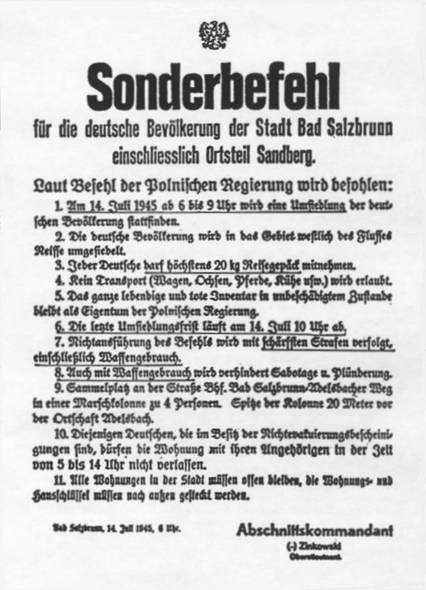
Quellennachweis
Wilhelm Kammeier: Die
Fälschungen der deutschen Geschichte
Lothar Greil: Slawenlegende
Franz Wolff: Ostgermanien
Richard Suchenwirth: Der
Deutsche Osten
Rudolf Trenkel: Der
Bromberger Blutsonntag
Rudolf Trenkel: Polens
Marsch in den 2.ten Weltkrieg
Peter Aurich: Der
deutsch-polnische September 1939
Walther Steller: Grundlagen
der deutschen Geschichtsforschung
Kurt Relle: Die
unbewältigte Heuchelei
Freda Utley: The
High Cost of Vengeance
Wydawnyctwo Interpress: POLEN